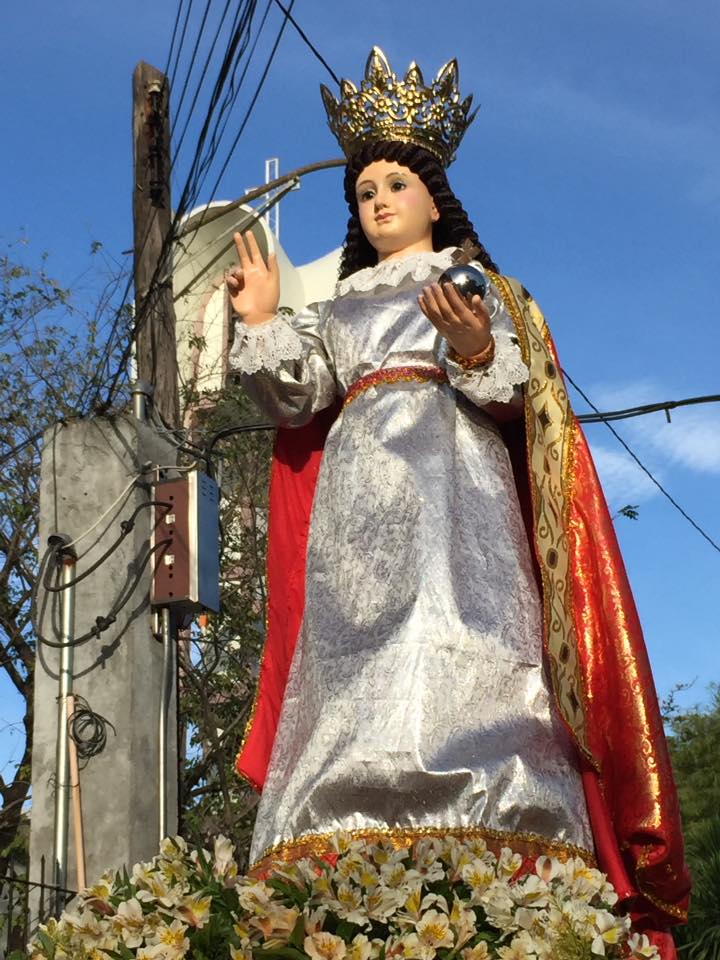
The readings today testify to who
the Santo Niño is. Many of us here are devoted to the Santo Niño. Who is the
Santo Niño: he is the Son of God! Let us not forget it. The Santo Niño raises
his hand in blessing us. The reason why we are blessed in him with every
spiritual blessing in the heavens is because the Santo Niño is the Son of God.
His Father is God and therefore he is Lord and God. If the Santo Niño were not
God, then we will never be chosen in him to be adopted as children of God. Wednesday, January 23, 2019
God who is a Child
The readings today testify to who
the Santo Niño is. Many of us here are devoted to the Santo Niño. Who is the
Santo Niño: he is the Son of God! Let us not forget it. The Santo Niño raises
his hand in blessing us. The reason why we are blessed in him with every
spiritual blessing in the heavens is because the Santo Niño is the Son of God.
His Father is God and therefore he is Lord and God. If the Santo Niño were not
God, then we will never be chosen in him to be adopted as children of God. Thursday, January 25, 2018
Sto. Nino: Let the children come to me
Wednesday, January 18, 2017
The Fearless Surrender of a Little Child
Children are usually told to watch and learn from adults. Adults like us are always presented to them as models who they should imitate. But the mind of the Lord is different. He tells us: “Unless you turn and become like children, you will not enter the Kingdom of heaven.” Those who aspire to enter heaven must watch and learn from children. They are the models who we should all imitate if we want to be part of his Kingdom.
The Lord puts the little child in our midst today…the little child who oftentimes is relegated to the side because he has done nothing yet to prove his worth. The child has not proven his worth because he does not yet earn his keep nor has he achieved anything to assure him of his niche in society. And yet, when asked: “Who is the greatest in the Kingdom of heaven,” the Lord puts the child in the midst of his disciples and tells them: “Whoever humbles himself like this child is the greatest in the Kingdom of heaven.”
In this way, he reveals to us his
glory…for who is greater than Him who is the Lord? Jesus is the King of kings
and the Lord of lords. To him, all authority in heaven and on earth has been
given by the Father. And yet, in entering this world, he humbled himself and
became a little child. He diminished himself. He made himself small, because in
the Kingdom of God, littleness is the measure of greatness. Even Philosophy
affirms this: God is the simplest of all beings. In the image of the Sto. Niño, we see the true glory of Christ:
it is the glory of God’s only Son, full of grace and truth. Indeed, what the
world deems important (like power and wealth) is nothing in the sight of God. A
person’s true greatness is measured by his simplicity and child-like trust in
the Lord.“The surrender of the little child who sleeps in its Father’s arms” is the oblation that pleases the Father. This surrender is the way of trust that the Lord is asking us to offer to him. Self-sufficiency brings us nowhere. We need the Father and we should never hesitate to ask for his love. With confidence, we should approach him for “there is no detail of my life that is too tiny for his concern.” As Jesus became a little child in order to enter our world, so we should become like little children in order to enter heaven. Let us confidently walk this way of spiritual childhood – the way of unconditional surrender and trust in the Lord. He does not need anything from us except our love. Let us give him this love as this is all the Father wants from us. Let us ask the Santo Niño: “O Son of God, who for my sake took on the dependency of childhood, help me to accept the readiness of the Father’s grace.”
Sunday, January 19, 2014
The Challenge of Conversion to Child-like Nothingness
However, when asked about
greatness in the kingdom of heaven, the Lord Jesus puts a child in the midst of
his disciples and tells them, “Whoever humbles himself like this child is the
greatest in the kingdom of heaven.” When we look at the image of the Santo
Nino, we see the real implication of these words of the Lord. In the Santo
Nino, we see Christ who is King of kings and Lord of lords and yet has become a
little child. By his incarnation, God the Son, in assuming human nature, became
a little child. He humbled himself like a child. He became a child…and
therefore, is the greatest in the kingdom of heaven. In the humility of his
childhood, Jesus remained to be who he is: God’s only begotten Son in whom the
Father was well pleased. His humanity never diminished in any way his divinity.
He continues to be the one to whom is given every authority in heaven and on
earth. This little child is for ever Wonder-counselor, God-hero,
Father-forever, and Prince of Peace. His dominion is forever peaceful. As
David’s successor, his power is based on right and justice.God walked on our land, p. 100.)
Sunday, January 20, 2013
His Humility Is His Exaltation
Sunday, January 15, 2012
Without Evident Greatness

The much revered image of the Sto. Niño commemorates the holy childhood of our Lord Jesus – the hidden life during which, according to the Catechism of the Catholic Church, the Lord spent “the greater part of his life” sharing “the condition of the vast majority of human beings: a daily life spent without evident greatness, a life of manual labor.” (CCC, 531). This hidden life in Nazareth, about which the Sacred Scriptures gives very few details, embraces much of His life on earth. Whatever we know about our Lord in his public ministry took place only in the last 3 years of his life. 30 years of it was very much spent in anonymity, in hiddenness: “a daily life spent without evident greatness.” The Catechism tells us that one of the purposes of the Incarnation is for the Word of God “to be our model of holiness.” (CCC, 459.) This means that God desires that we imitate his Son so that we can become holy. Often, many people wonder how this can be possible. After all, much of what the Lord did were easily done because of his Divinity. It can be easy for us to justify our failure in imitating Christ by saying, “I am not God like Christ.” It is in His hidden life in Nazareth where the Lord is very much like us who spend our daily lives without evident greatness. The 8 million crowd who drew close to the Nazareno in the 22 hour long procession last Monday – they are the ones like us who spend their daily lives without evident greatness. The Lord spent much of his life being like most of us – without splendor, without evident greatness. It is in the mystery of his childhood that his life resembles very much like ours. And seeing him as so much like ourselves, we find it so much easier to draw close to Him. Perhaps, the similarity of the hidden life of Christ to our very ordinary selves is the reason why Reina Juana of Cebu chose the image of the Sto. Niño from the 3 images presented to her at her baptism. Perhaps, this same similarity becomes the reason for the Sto. Niño’s popularity. What Filipino home is without a Sto. Niño? We are comfortable in seeing the Almighty God as being so much like us. Here He is reachable. Here He is approachable. Here He is accessible. Looking at the Sto. Niño, we realize that the Christian life, as an imitation of Christ, is not impossibly difficult. This is so because God bent himself so low – He became like us, without evident greatness.
And he wants us to draw close to him in the ordinariness of our humanity. That is why he says, “Let the little children come to me. Do not prevent them.” Not only does he want the children to come to him. He wants us to approach Him like little children – without the evident greatness of adult achievement. Last Sunday, we said that one of the reasons why the Magi were believed to be kings is that they were received by Herod – something that can easily be done if they were kings. Today, Jesus receives children. He wants us to approach as children – without the trappings and complications demanded of adults. We can approach him even without proofs of achievements. And to make it easier, the Lord becomes a little child – a Child among children as Herod was king among the Magi who were kings.
“To such belongs the Kingdom of God” – when we look at the Sto. Niño, we see him dressed as King and rightly so. After all, He is the owner of the Kingdom of God. “God will give him the throne of David his father, and his kingdom will be without end.” But in the image of the Sto. Niño, we see this King in the utter ordinariness of a Child. This King is a Child. As a child, He is so much like us. As King, He is so much above us. As a child, He makes it easy for us to approach Him. As King, He gives us the reason why we must approach Him – He has the power to give us what nobody else can: access to the Kingdom of God.
Sunday, January 16, 2011
Divinity and Humanity