Showing posts with label St. John the Baptist. Show all posts

Friday, January 18, 2019

Simbang Gabi 2018 9: The Dawn before Christmas morning


SIMBANG GABI 2018 9
YEAR OF THE YOUTH
DECEMBER 24, 2018

Jesus, I trust in you!

Simbang gabi ends today. We have been coming to Mass for 9 dawns already and the novena fittingly ends with a clear reference to the dawn: “In the tender compassion of our God, the Dawn from on us will break upon us to shine on those who dwell in darkness and the shadow of death and to guide our feet on the way of peace.” (Sa kagandahang loob ng ating Diyos na magpapadala sa atin mula sa kaitaasan ng isang araw na sumisikat upang liwanagan ang mga nakaupo sa kadiliman at sa lilim ng kamatayan , upang ituwid ang ating mga yapak sa daan ng kapayapaan.)  Advent commemorates that long wait for the coming of the Savior. It was a waiting in the darkness of error and sin. St. Peter spoke of it: “We also have the message of the prophets, which has been confirmed beyond doubt. And you will do well to pay attention to this message, as to a lamp shining in a dark place, until the day dawns and the morning star rises in your hearts.” (Sa gayon ay tumitibay ang sinasabi ng mga propeta: mabuti ang inyong gagawin kung mamasdan ito, na gaya ng isang ilawan na tumatanglaw sa dakong madilim, hanggang sa pagbubukang liwayway at sa pagsikat ng tala sa umaga sa inyong mga puso.)  (2 Peter 1: 19) The world waited in the dark with only God’s revelation, his word of promise, as a lamp to look at until the dawning of the promised day and the rising of Christ, the morning star in our hearts.

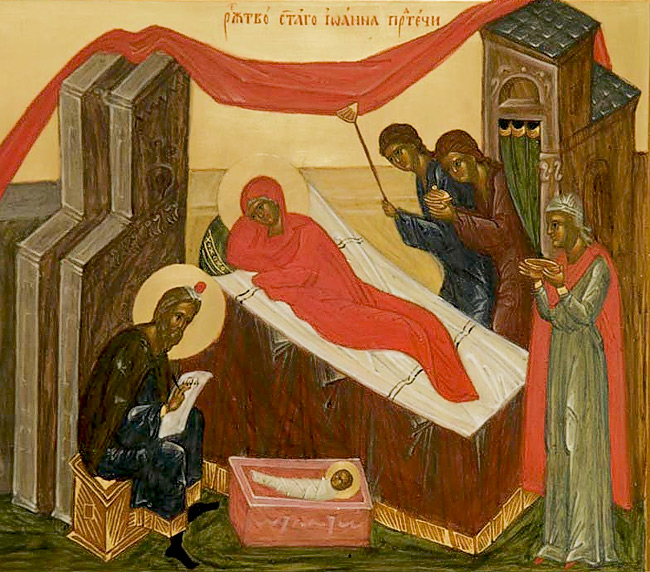
John the Baptist was born and his birth puts an end to the long silence of God. For a long time, God sent neither prophet nor prince to his people. It was as if God got fed up with the constant adultery of his people that he decided to give them the “silent treatment.” The nine month silence of Zechariah was a sign of this. Remember that Zechariah was made mute by the angel who appeared to him before John was conceived. And when the child was circumcised and was named “John”, Zechariah’s tongue was loosened. He began to speak in prophecy. At last, God speaks to his people. At last, he has sent a prophet to them. And the purpose of the sending of the prophet was to prepare the way for the coming of the Word of God himself: “You, my child, shall be called prophet of the Most High, for you will go before the Lord to prepare his way, to give his people knowledge of salvation by the forgiveness of their sins.” (Ikaw naman, sanggol, ay tatawaging propeta ng Kataas taasan, sapagkat mangunguna ka sa Panginoon upang ihanda ang kanyang daraanan, upang ituro sa kanyang bayan ang kaligtasan sa kapatawaran ng kanilang mga kasalanan.)

The birth of John was the sign that the long wait is about to end. “The night is far spent and the day draws near…” so would St. Paul say. Soon the darkness will be over. The night will give way to the dawn. The Light of the world will be born and he will dispel the darkness of error, sin, and death. And when the day comes, we shall all see what was hidden from us under the cloak of darkness. When the darkness of sin is lifted up, we shall see how beautiful the world was meant to be. We shall see how wonderful is the life that God intended to give us. On that day, we shall realize how much the devil has stolen from us and what he has deprived us of.

Dawn is the beginning of day. It is a fresh start, a new beginning. Tired and weary, we rest our bodies in sleep. We wake up fully refreshed at dawn. Whatever mistakes we have done, whatever filth we have incurred, all these will pass away together with the darkness that is dispelled by the first streaks of the light. The Lord allows us to rise to a promise. Dawn is the opportunity to start all over again.
And this is the dawn of Christmas morning. Most of us have wonderful memories of childhood Christmas mornings. I have my own. When I was a child, I woke up on Christmas mornings always with a sense of awe. I was awed by the gifts beneath the Christmas tree and by the goodies left by Santa on the socks I hang on the wall. I hope, that tomorrow, on Christmas morning, all of us will awake with child-like wonder. Let us be like wide-eyed children as we behold the gift on God beneath the Tree of the Cross: his only begotten Son who will be born of the Virgin. When you behold him, pray to him and ask him to take away your sorrows and wipe away your tears. Ask him to dispel your darkness and drive away your fears. Ask him to forgive your sins and bring you to forgive others as well. Soon, we shall see the promise of Christmas morning. Tonight, let us go to sleep with hope in our hearts. Whatever darkness you are going through, it will come to end. The dawn from on high shall break upon us!

O Mary conceived without sin, pray for us who have recourse to thee!

Simbang Gabi 2018 8: The Messenger who goes before the Lord


SIMBANG GABI 2018 8
YEAR OF THE YOUTH
DECEMBER 23, 2018
 
Jesus, I trust in you!

Advance party…this is the most appropriate description I can give of the birth of John the Baptist. If there is any significance in this birth, it is not that he was sort of a miracle baby born to aged parents. It is also not that his father’s tongue was loosened on the day of his circumcision. The significance of this birth is described by the prophet Malachi: I will send my messenger before you to prepare the way before you.”  This baby is no ordinary messenger. He was likened to the Prophet Elijah, the greatest of all the prophets. He had to come in the spirit of the greatest prophet because the one who will be born after him, the one whose path he must prepare, is the Almighty God. “Who can endure the day of his coming and who can stand at his appearance? He is like the refiner’s fire and fuller’s lye; he will sit as a refiner and a purifier. He will purify Levites like gold and silver.” Obviously, the preparation needed is more than just planning parties and banquets. It would involve much more than gifts and decorations. Because the one coming is Almighty God, preparing for him will involve purification from sin so that the worship we shall offer to him will be truly pleasing and acceptable to him.

The advanced party is now here…it only means that the Lord will follow soon. In fact, in (2) a day’s time, it will be Christmas morning. Are you prepared for it? You have probably made a list of things to do and of people to send gifts to. Have you made your list and checked them twice? But with Noche Buena and gifts prepared, can you really say that all is set? How about your soul? Are you purified enough? Have you gone to confession? Malachi said: “He shall turn the hearts of the fathers to their children, and the hearts of the children to their fathers.” Have you mended broken relationships? Mga kabataan, may atraso ba kayo sa inyong mga magulang? Nakahingi na ba kayo ng tawad? Parents, have you neglected your children? Have you made up for your neglect? Bully boy whose video went viral definitely was the product of parental neglect. For if it were not so, then how did he grow up filled with so much hatred? Obviously money is not the only element of child rearing. More important than money would be time, attention, and discipline. How is your family? Is it prepared to welcome the Lord? Are you now reconciled and at peace with each other? Perhaps, if you have been concerned with external preparations and have neglected the spiritual and relational preparations, you have the last two days to fix things and so be prepared for the Lord’s coming.

“Look up and see: your redemption is at hand.” It is only when we are spiritually prepared that we can recognize the great gift the Lord bestows upon us. And believe me…the Lord has shown us so great a favor. It will be just so sad to miss it simply because we were not prepared to see it. Ask the Lord to silence your heart so that you may hear his voice. Ask him to open your eyes so that you may recognize him who comes. Ask him to purify and humble your heart so that you may welcome him with great joy.

O Mary conceived without sin, pray for us who have recourse to thee!
Thursday, January 17, 2019

Simbang Gabi 2018 6: Empowered by the Holy Spirit


SIMBANG GABI 2018 6
YEAR OF THE YOUTH
DECEMBER 21, 2018

Jesus, I trust in you!

Upon discovering from the angel that her elderly cousin Elizabeth was pregnant, Mary set out in haste to visit her and attend to her needs. But it was not her alone who went to visit nor was Elizabeth alone who was the object of the visit. Mary was carrying in her womb the Son of God who had just been incarnated. On the other hand, John the Baptist has been living in his mother’s womb for six months then. Mary went to visit Elizabeth. Jesus went to visit John. Mary went to visit Elizabeth to help her through a difficult pregnancy. Jesus went to visit John to sanctify him with the Holy Spirit even though he was still in his mother’s womb: “He will be filled with the Holy Spirit even from his mother’s womb,” so said the angel to Zechariah at the temple. Little did Mary realize that she was doing more than just assist her cousin for at that moment when John was sanctified in his mother’s womb, Jesus was already saving him. That moment of charity became a moment of salvation. Beneath what was visible, something invisible was wonderfully taking place.

The Holy Spirit overshadowed Mary and thus made the Incarnation possible. But let us not forget that the Holy Spirit did something more in Mary. He inspired her to go to Elizabeth. In fact, the conversation between Mary and Elizabeth was a Spirit-filled conversation. When Elizabeth heard Mary’s greeting, the baby in her womb leaped for joy and she, filled with the Holy Spirit, declared Mary’s blessedness as Mother of the Lord.

Young people, the Holy Spirit whom John received in his mother’s womb is the same Holy Spirit we received on the day we were baptized. He is the same Holy Spirit who overshadowed Mary and empowered her. Thus, you and I are empowered also by the Holy Spirit. He empowers us with his supernatural gifts. As our helper, the Holy Spirit in us empowers us to live lives that radiate the goodness of God. He helps us to be who God created (intended) us to be. He is the power who sustains, energizes, and keeps us on a holy path. The Holy Spirit makes us holy. He purifies us from our sins through the Sacrament of Confession. He helps us convert and be Christ-like. He transforms us into the image of Christ. The Holy Spirit directs and helps us to do the will of the Father. The Holy Spirit imparts to us gifts that will help us serve the Church. He empowers us to fulfill the calling God has placed on our lives. He pours on us the love of God to sustain us through difficult moments. He keeps hope alive in us through such moments by reminding us that we are constantly loved by God. He helps us pray most particularly when it seems too difficult to pray because our sorrows are too great. He reminds us of what Jesus said and taught us, especially when the trials seem to be too great. And most of all, the Holy Spirit makes us witnesses for Jesus. As the Holy Spirit pointed out to John the Baptist the hidden presence of Jesus in the womb of Mary, so also does he point out the hidden presence of Jesus to the world. This is what we testifies to us. He keeps reminding us that the Lord is near. He reveals to the world the Gospel and he does this through us. Therefore, we should not shy away from being advocates for Christ. Nor should we worry about what to say. The Holy Spirit will put these words on our lips. And those words will be powerful words. Look at what the Holy Spirit placed on the lips of Mary. It was just a greeting but when this greeting reached Elizabeth’s ears, the baby in her womb leaped for joy. Through that greeting, John was sanctified.

We are an empowered people. Baptism gave us the Holy Spirit. Let the Spirit make us go in haste to bring the Gospel to our friends and to all people. Young people, you are gifted. More than just your innate talents, you are gifted with something more. You have received the Holy Spirit. Go and share the Gospel. In the power of the Holy Spirit, be disciples. In the power of the Holy Spirit, make disciples.

O Mary conceived without sin, pray for us who have recourse to thee!

Simbang Gabi 2018 4: A Life of Purpose

SIMBANG GABI 2018 4
YEAR OF THE YOUTH
DECEMBER 19, 2018

Jesus, I trust in you!

Even before they were conceived and were born, both Samson and John the Baptist had a purpose for living. These were both revealed by angels to their own parents. The angel said to the mother of Samson that her son will begin the deliverance of Israel from the power of the Philistines. The angel Gabriel said to Zechariah that his son will prepare a people fit for the Lord. Samson was consecrated to God from the womb. John will be filled with the Holy Spirit even from his mother’s womb. Being consecrated to God means that a person belongs to him. This is a sign of God’s love and mercy towards the promised child and to the parents who will receive him from the Lord. Elizabeth, the wife of Zechariah, declared: “So has the Lord done for me at a time when he saw it fit to take away my disgrace before others.”

The Responsorial Psalm sings of the praises of God coming from a person who recognized the Lord’s singular love for him. “You are my hope, O Lord, my trust, O God, from my youth. On you I depend from birth; from my mother’s womb you are my strength. I will treat of the mighty works of the Lord; O God, I will tell of your singular justice. O God, you have taught me from my youth, and till the present I proclaim your wondrous deeds.” (Ikaw ang aking pag-asa, O Diyos ko; ang aking pinanaligan, Panginoon, mula pa sa aking pagkabata. Mula pa sa aking pagsilang ikaw na ang umaalalay sa akin; mula pa sa sinapupunan ng aking ina ikaw na ang aking lakas. Isasalaysay ko ang kapangyarihan ng Diyos; O Panginoon, ipapahayag ko ang katangi-tangi mong kabanalan. O Diyos, tinuruan mo ako mula pa sa aking pagkabata, at hanggang ngayon ay ipinahahayag ko pa ang iyong mga kababalaghan.) These words should be proclaimed by all people, and especially by the youth. It is because like Samson and John the Baptist, each of us were created for a life of purpose (may layunin ang buhay). We do not lead meaningless lives because God always has a reason for creating something. He does not create anything without meaning or purpose. The mere fact that we were created…the mere fact that we exist is the proof that we have a purpose for existing (may dahilan sa pamumuhay). There is always an answer for the question: Para saan ka bumabangon? Para kanino ka bumabangon?

Perhaps, for some, their purpose is not clear because they keep on looking at themselves in reference to people who do not seem to appreciate the gift of their persons. And this is sad. When we feel unappreciated, it is because we fail to see ourselves the way God looks at us. Each person is a gift. Samson was God’s gift not only the Manoah and his wife. He was God’s gift to the people of Israel who are to be delivered by him from the Philistines. John was God’s gift not only to Zechariah and Elizabeth but to the people who will be prepared by him for the Lord. You are a gift…otherwise, you will not be here on earth. One day, that purpose will be clear…you will mean something to someone because right now, you mean something to the Lord. No one is useless because God does not make trash.

Dear young people, you are beloved by God. From your mother’s womb, God called you to belong to him. Place your hope in the Lord. Trust him. Let the Lord be your strength. Let your life be one long song of thanksgiving to the Lord. You can only thank the Lord the moment you recognize that you are a gift. You are a gift of God to those who love you. You are a gift of God to the world. You are a gift of God to yourself. You did not create yourself. God did. And because of this, you have a purpose. God does not create meaningless creatures. God does not do things without a purpose.

 Mary conceived without sin, pray for us who have recourse to thee! 

Simbang Gabi 2018 1: The Winnowing Fan


SIMBANG GABI 2018
3RD SUNDAY OF ADVENT C
DECEMBER 16, 2018

Jesus, I trust in you!

The beginning of Simbang Gabi this year coincides with the 3rd Sunday of Advent which is known as the Gaudete Sunday or the Day of Rejoicing. Both occasions which coincide on the same day tell us of the same message: The Lord is near! Therefore we should rejoice. And by now, many of us feel the pressure of the approach of the holy days. Traffic is exceedingly heavy because everybody wants to do last minute Christmas shopping. After all, we are down to the last 9 days to Christmas. And also let us not forget the many Christmas parties we must attend…even if it were still only in the Advent Season. All of these constitute our preparations that we must fulfill because Christmas is near. “Now the people were filled with great expectation,” so the Gospel tells us. I suppose that these words apply to us as well.

But what are we expecting? Who are we expecting? Are we expecting gifts? Food? Liquor? The return of some long separated loved one? Reconciliation with a former friend? What is is that we are expecting? In the time of John the Baptist, people were clearly expecting the coming of the Christ. They were all asking in their hearts whether John was the Christ they were waiting for. And John was quick to say: “The one mightier than I is coming. I baptize you with water but he will baptize you with the Holy Spirit and with fire. His winnowing fan is in his hand to clear his threshing floor and to gather the wheat into the barn, but the chaff he will burn into unquenchable fire.”

The winnowing fan. Farmers know what this is all about. After the harvest, the grains are collected and pounded (bayuhin) and they are thrown before a powerful fan. The fan blows away the chaff (balat) while the grains fall to the ground. The chaff are easily blown away because they are empty. The grains are heavier, therefore these fall into the ground.

And so we, who find ourselves amidst the frenzy of holiday preparations must ask ourselves: If our preparations are thrown before the winnowing fan, will they be blown away because they are empty? Or will they fall to the ground because they are substantial and real preparations?

“What must we do?” the people asked John. So also should we ask him as well. And John answers us: share and change. “Whoever has 2 cloaks should share with the person who has none. And whoever has food should do likewise.” Isn’t this the filling of the valley that he referred to last Sunday? And to the tax collectors he said, “Stop collecting more than what is prescribed.” To the soldiers he said, “Do not practice extortion, do not falsely accuse anyone. Be satisfied with your wages.” Aren’t these the leveling of the mountains that he referred to last Sunday? By sharing what we have, no matter how little they may be, we fill up the valleys. By cutting down our sinful ways, we level the mountains. This is the substantial preparation for the Lord’s coming. “Your kindness must be known to all. The Lord is near,” said St. Paul.

As every Advent brings us closer to the end, so we should make sure that every Advent increases us in holiness and decreases us in sinfulness. Remaining unchanged from one Advent to another is a waste of so much opportunity given to us by God. Remember that as the deadline draws near, we should be progressing in the work assigned to us. The closer we get to the end, the more task we should have accomplished so that when the time is up, we have something to present, something to offer to the Lord. When we are told that the Lord is near, it means that the struggle for holiness will not be for long. Therefore, let us urge one another to go on and not to abandon the fight. The Lord is near. His recompense (kabayaran) comes with him. Soon, we shall rest from our labors. Soon, we shall be rewarded for our faithful service. It won’t take long. The Lord is near. Our salvation is at hand.

O Mary conceived without sin, pray for us who have recourse to thee!

Wednesday, December 27, 2017

Simbang Gabi 9: The Priest as Herald of the world to come

SIMBANG GABI 2017 9
YEAR OF THE CLERGY AND CONSECRATED PERSONS
DECEMER 24, 2017
 
Jesus, I trust in you!

On the last day of the Simbang Gabi, we hear Zechariah’s song of praise. Remember that he was silenced for 9 months and on the day of the circumcision of his newly born son, his mouth was opened, his tongue loosed, and he began singing the praises of God. His is a fitting song because it was basically about the end of the night of waiting and the coming of the dawn: “In the tender compassion of our God, the dawn from on high shall break upon us to shine on those who dwell in darkness and the shadow of death and to guide our feet into the way of peace.”
Every Advent, St. Paul reminds us that “The hour has come for you to wake up from your slumber, for our salvation is nearer now than when we first believed. The night is far spent; the day draws near. So let us lay aside the deeds of darkness and put on the armor of light.” (Rom 13:11-12) He compared the time of waiting to night and the coming of salvation to the drawing near of the day. And every Advent brings us closer to that promised day. Zechariah ends our Advent journey by referring to the dawn from on high breaking upon us. He recognized that his son, John the Baptist, is the one “who will go before the Lord to prepare his way.” He could almost see the end of the long wait. His son is the precursor and he prepares the way of the one who is sure to follow. The Dawn of Salvation is so close. He is sure to come.

The Precursor of the Lord
This is the witness of John to the coming of the Lord. The priest also gives witness to the same coming of the Lord. He points out the nearness of salvation. Not only does the priest bring Christ closer to people by making him present in the preaching of the word and the celebration of the sacraments, he himself gives witness to the world about the coming end…the day of the resurrection. Leaving his biological family, the priest puts himself in the service of the family of God. His celibacy does not only provide the availability that he needs to fully serve the kingdom. His celibacy is also the sign of the world to come where men and women no longer will marry not be given to marriage because they will be like the angels. His priestly service will be the only one that remains in heaven. In the afterlife, doctors, soldiers, architects, engineers, teachers and other professions will no longer be needed. There is only one thing that we shall do in heaven and that is to worship God for all eternity. That is why Christ’s priesthood is an eternal priesthood. It is one that does not cease on earth but rather in continues in heaven for all eternity.

It is when the priest comes to anoint the sick and to minister to the dying that he clearly becomes a herald of the nearness of the dawn. Oftentimes, people are afraid of calling for a priest because they mistakenly think that the priest is the bringer of death. The priest is not the bringer of death because whether he comes or not, death will come upon a person if his time is already up. The priest comes with the consolation of the sacraments. He provides for the dying person the spiritual helps he needs as he prepares for his final battle on earth. Remember that Satan wants the dying person’s soul. That is why he uses all the tricks and deceptions in his book in order to instill in a person some sense of despair, some thought that he cannot be saved. That is why a person’s greatest battle will be the hour of his death. This is the reason why the ministry of the priest is very important at that moment. The priest comes in the name of Christ. He provides for the dying the forgiveness of sins and also the help of the Holy Spirit so that the person might remain steadfast in his faith in Jesus. The priest is not the bringer of death. Rather, he is the bringer of hope. He is the bringer of mercy. He is the bringer of strength in that moment of great spiritual distress. When a priest ministers to the dying, he is like Zechariah who says: In the tender compassion of our God, the dawn from on high shall break upon us. He, who is ministered to by a priest, will surely close his eyes in this world and will open then in the next, in the world of the eternal day. He need not fear the night of death because the sacraments will make sure that the eternal day will come.

O Mary conceived without sin, pray for us who have recourse to thee!


Simbang Gabi 8: The Priest as Minister of the Word

SIMBANG GABI 2017 8
YEAR OF THE CLERGY AND CONSECRATED PERSONS
DECEMBER 23, 2017

Jesus, I trust in you!

When the angel Gabriel announced to Zechariah the birth of John the Baptist, he had difficulty believing in it. Thus, he was made speechless, unable to talk until the day of the fulfillment of the words of the angel. And so, he spent 9 months in silence. Deprived of voice, Zechariah experienced what the prophets of old lamented in the past: “We have in our day no prince, prophet, or leader, no burnt offering, sacrifice, oblation, or incense, no place to offer first fruits, to find favor with you.” (Daniel 3:38) The silence of the Lord was a deafening silence.

It was at the circumcision of John when the silence ended. Asked about the name of the child, Zechariah wrote: His name is John. “And immediately his mouth was opened, his tongue freed, and he spoke blessing God.” The birth of John brought about not just the end of the silence of Zechariah but also the end of the silence of God. At last, a prophet was sent. And the one who was born was not just a prophet. He is the voice in the wilderness who would declare: “Prepare the way of the Lord.” The voice is born. The Word will follow soon.

The birth of John the Baptist gives us the occasion to speak about the Priest as the Minister of the Word. “The People of God is formed into one in the first place by the Word of the Living God, which is quite rightly sought from the mouth of priests. For since nobody can be saved who has not first believed, it is the first task of priests as co-workers of the bishop, to preach the Gospel to all men.” (Presbyterorum Ordinis, 4.) The first task of priests is to preach the Word of God. The priest is ordained to preach. He carries out the mandate which Christ gave to the apostles: “Go to all the world and preach the Gospel to all creatures.” This task is vital for the Church. “By the saving Word of God, faith is aroused in the hearts of unbelievers and is nourished in the hearts of believers. By this faith, the congregation of believers begins and grows according to the saying of the Apostle: ‘Faith comes from what is heard, and what is heard comes from the preaching of Christ.’ (Rom. 10:17) ” (PO, 4.)

Thus, it is important that priests share the Gospel to everybody. “Whether by having their conversation heard among the gentiles they lead people to glorify God, or by openly preaching proclaim the mystery of Christ to unbelievers, or teach the Christian message or explain the Church’s doctrine, or endeavor to treat of contemporary problems in the light of Christ’s teachings – in every case, their role is to teach not their own wisdom but the Word of God and to issue an urgent motivation to all men to conversion and to holiness.” (PO, 4.) Like John the Baptist, the priest is just the voice. He is not the Word. The only Word is Christ. He speaks not in his own name. He repeats the words of Jesus himself: “The word that I speak is not mine but of the one who sent me.”

Because the word he speaks is not his but of the One who sent him, the priest “ought first of all to develop a great and personal familiarity with the word of God…He needs to approach the word with a docile and prayerful heart so that it may penetrate his thoughts and feelings and bring about a new outlook in him…Nor should (he) forget that ‘the greater or lesser degree of the holiness of the minister has a real effect on the proclamation of the word.’ As St. Paul said: ‘we speak, not to please men but to please God who tests our hearts’ (1 Thess. 2:4). If we have a lively desire to be the first to hear the word which we must preach, this will surely be communicated to God’s faithful people, for ‘out of the abundance of the heart, the mouth speaks.’ (Mt. 12:34)” (Pope Francis, Evangelii Gaudium, 149.)

Thus, the priest must be a man of the word of God. He is, first of all, an obedient listener and then an ardent proclaimer. He is the voice and not the Word. He is its servant and not its master. Like Zechariah, the priest must open his mouth and speak the praises of God.


O Mary conceived without sin, pray for us who have recourse to thee!  

Tuesday, December 26, 2017

Simbang Gabi 6: The priest as vessel of Divine mysteries

SIMBANG GABI 2017 6
YEAR OF THE CLERGY AND CONSECRATED PERSONS
DECEMBER 21, 2017

Jesus, I trust in you!

Having heard that Elizabeth was pregnant in her old age, Mary immediately went in haste to the house of Zechariah so that she may be of some help to her cousin. But what transpired revealed that something mysterious happened…something which the eye could not see. When Elizabeth heard Mary’s greeting, she was filled with the Holy Spirit and the Baby John leaped in his mother’s womb. It was a moment of salvation because as the angel said to Zechariah, “He will be filled with the Holy Spirit in his mother’s womb.” John, who was conceived in original sin, was sanctified by the Holy Spirit on the 6th month of his mother’s pregnancy. Thus, in his mother’s womb, John was liberated from original sin.

The sanctification of John in his mother’s womb could only point out to what was yet invisible to the human eye, and that is the presence of Jesus in Mary’s womb. And so, it was not only Mary who went in haste to visit Elizabeth. She brought Jesus whom she carried in her womb. Elizabeth, filled with the Holy Spirit, acknowledged this when she said: “Blessed are you among women, and blessed is the fruit of your womb.”

The priest also lives in a similar way. As a man consecrated to God, the priest bears in himself the presence of God. “But we have this treasure in earthen vessels, so that the surpassing greatness of the power will be of God and not from ourselves…” (2 Cor 4:7) The priest may be a human being like other human beings, frail, weak, and sinful. He is so much unlike the Blessed Virgin who is pure and unstained by any sin. And yet, in spite of his sinfulness and weakness, the priest carries with him an anointing that makes the presence of God felt wherever he goes. When our Lord sent his disciples to go in pairs in every town, he admonished them to take nothing with them except the blessing of God: “Take nothing with you…into whatever house you enter, say “Peace be with you!’ If a peaceful man lives there, your peace will rest on him but if not, your peace will return to you.” The presence of a priest should bring about God’s blessings upon a place. He comes in the name of the Lord.

The priest is the conduit of God’s blessings upon the world. As Elizabeth and John were sanctified by the Lord through the Blessed Virgin, so also people are sanctified by the same Lord through the presence of the priest. This is why it is important for a priest to pursue a holy life because he must first be sanctified by the mysteries he bears so that he can sanctify others. Contrary to present opinions that the priest must conform himself to present trends and fashions of the world, he must actually strive to conform himself to Jesus in whose Name he comes. The priest must strive to be a man of the Spirit more than of the flesh. He must strive to be a man of God and not a man of the world. The priest should strive to live a life worthy of his consecration.

Elizabeth was blessed to welcome Mary into her home. But remember that Our Lady did not go to Elizabeth’s house for the adulation. She went there to serve her cousin in the hour of need. In like manner, it may seem unavoidable that the priest be considered a welcome guest in homes and other places. But he goes not for the adulation. He goes to serve. He goes so that he may bring Christ closer to people. He goes to bring Christ’s blessing to them.

O Mary conceived without sin, pray for us who have recourse to thee.


Sunday, December 24, 2017

Simbang Gabi 4: The Priest and the Sacrifice

SIMBANG GABI 2017 4
YEAR OF THE CLERGY AND THE CONSECRATED PERSONS
DECEMBER 19, 2017

Jesus I trust in you!

The calculation of the date of the birth of the Lord is really based on the story told by the Gospel today. The Angel Gabriel announced the birth of St. John the Baptist to Zechariah as he was fulfilling his temple duties during the evening sacrifice on Yom Kippur or the Day of Atonement, which normally is offered in the month of September. Zechariah was serving in the temple because he was a priest. He came from the tribe of Levi which was the priestly tribe of Israel. Because he was a priest, Zechariah performed duties related to worship.

This is basically the work of a priest. In every religion, there are priests tasked to offer the highest act of worship, and that would be the offering of a sacrifice to the deity. The offering of the sacrifice was a sublime task because it was and continues to be the highest act of worship. The sacrifice is the highest act of worship because it involves the killing of an animal or a human victim in acknowledgment of the deity’s dominion over life and death.

Before the Levites were appointed as the priestly tribe, the offering of the sacrifice was the work of the head of the household, a work that was later passed on to the first-born son. After the worship of the golden calf at the foot of Mount Sinai, the offering of the sacrifice was given as the task of the sons of Levi who were the only tribe that did not take part in the idolatrous worship.  And so the sons of Levi took turns in their temple duties and that was what Zechariah was doing when the angel appeared to him.
Christ’s offering of himself on the wood of the Cross is the most perfect sacrifice because what was offered to God was not the blood of any animal nor that of any human being but that of God’s only begotten Son. This perfect sacrifice of Jesus nullified all other sacrifices because nothing else will be as worthy of Divine Majesty as the offering of God’s Son. Thus, at the death of Jesus, the temple curtains were rent into two, marking the end of all sacrifices to give way to the one perfect sacrifice of Jesus.

Jesus perpetuated his sacrifice by establishing the Holy Mass during the Last Supper. On Holy Thursday, he established the Holy Eucharist and in order to perpetuate it, he ordained his apostles as priests. He had to ordain priests because only priests can offer the sacrifice. “God, who alone is the holy one and sanctifier, has willed to take men as allies and helpers to become humble servants in his work of sanctification. The purpose for which priests are consecrated by God through the ministry of the bishop is that they should be made sharers in a special way in Christ’s priesthood and, by carrying out sacred functions, act as his ministers who, through his Spirit, continually exercise his priestly function for our benefit in the liturgy.” (Presbyterorum Ordinis, 5.)
The offering of the Eucharist is the center of the life of the Church. “The other sacraments and all ecclesiastical ministries and works of the apostolate are bound up with the Eucharist and are directed towards it. For in the most blessed Eucharist is contained the whole spiritual good of the Church, namely Christ himself our Pasch and the living Bread which gives life to men through his flesh – that flesh which is given life and gives life through the Holy Spirit.” (PO, 5.)

Because of the supreme importance of the Mass in the life of the Church, the work of the priests is so important. Without priests, the sacrifice cannot be offered. Without the sacrifice, God cannot be worship in a way he rightfully deserves. “The Eucharistic celebration is the center of the assembly of the faithful over which the priest presides.” (PO, 5.) Let us assist at the most perfect Sacrifice. Let us teach our children to love the Mass. Loving the Mass, we will love God all the more because through the hands of the priest, we offer God the one whom he loves the most: Jesus Christ his Son.


O Mary conceived without sin, pray for us who have recourse to thee!

Saturday, December 23, 2017

Advent 3: The unrecognized One among you!

Jesus, I trust in you!

Rejoice in the Lord always…Indeed the Lord is near!
John the Baptist was at the center of the limelight. People went out into the desert to hear him preach and have themselves baptized by him. The Lord Jesus even said that John the Baptist was a shining light and people rejoiced in that light. Light has a natural power to give joy. Do we not instinctively clap our hands when light is restored at the end of a brown out? People thought that John the Baptist was the light. But he told them that he was not the Christ. “He was not the light but came to testify to the light.” He came to prepare the way of the Lord.

The light he testified to is Jesus. Jesus is the true light of the world. He is the one who gives joy to the world: I have told you this so that my joy may be in you and your joy may be complete (John 15:11) Jesus was sent “to bring glad tidings to the poor, to heal the brokenhearted, to proclaim liberty to captives and release to prisoners, to announce a year of favor from the Lord.” His coming to us brings us joy. The joy that Jesus brings is the joy that comes from the closeness of God to us.

That is why it surprises us that Christmas depresses people. We hear Christmas songs that express loneliness: “Ang Disyembre ko ay malungkot…” “Pasko na sinta ko, hanap hanap kita…” Why do people get depressed during Christmas? Why are they overcome by sadness? I think it is because we have become too engrossed with ourselves. We keep on looking at ourselves so much that we begin to see what we do not have…what we lack. I am sad because I do not have you. I am sad because we are not together. I am sad because I do not have.

Looking too much at my own self, I become miserable. I have forgotten that Christmas is not about me. It is about Jesus whose birthday it celebrates. John the Baptist explains our misery: “There is one among you whom you do not recognize, the one who comes after me.”  Our poverty makes us so sad that we fail to recognize him who brings glad tidings to the poor. Our broken hearts take up so much of our attention that we fail to recognize him who heals the broken hearted. We are captives of our own selves, imprisoned in our self-centered lives that we fail to recognize him who proclaims liberty to the captives and release to the prisoners. We are sad because we think that the Lord has abandoned us. This is not true! The Lord is near us especially in our sorrows. He is closer to us more than we can ever imagine. He is so close to us. We simply do not recognize him. If only we look beyond ourselves and look at Jesus, we will hear him announce to us a year of favor from the Lord.

Although John the Baptist was a shining light, people rejoiced in his light but only for a while. He was not the light. Our joy is not in John but in Jesus. Jesus is the true light who shines on every man. The one who follows him will never walk in darkness but will always have the light of life. “In Jesus lies salvation. In Him it is possible to find interior peace and the strength to face different life situations every day, even the most difficult ones…we are filled with peace because we know how to place our joy in the Lord even when going through the most difficult moments in life. To have faith does not mean never to have difficult moments but to have the strength to face those moments knowing that we are never alone. This is the peace that God gives his children.” (Pope Francis, Angelus Message, December 14, 2014.)


O Mary conceived without sin, pray for us who have recourse to thee!

Advent 2: burning excesses and making up for lack of goodness

Jesus, I trust in you!

We know that Christmas is just around the corner when traffic becomes heavier and malls and night markets become busier. People are just so busy “buying special gifts, making time to be friends to one and all.” Everybody is so busy preparing for the most wonderful time of the year.

While nothing is wrong with shopping and with partying, it is only right for us to keep our focus on the real reason for the holidays. If Advent is a time of preparation, what are we preparing for? Many of us will immediately conclude that we are preparing for the feast of the Lord’s birth. All these parties and gift giving celebrate the mystery of the incarnation of the Son of God.

While this may be true, we must not forget that Advent does not only prepare us for Christmas. Advent also prepares us for the coming of the day of the Lord when “the heavens will vanish with a roar; the elements will be destroyed by fire, and the earth and all its deeds will be made manifest.” (Sa araw na iyon, ang kalangitan ay biglang mapaparam na may nakapangingilabot na ugong, matutupok ang araw, buwan at mga bituin, at ang lahat ng lupa ay malalantad.) We are waiting for that awesome day of judgment when all the earth will make an accounting before Christ.

St. John the Baptist of Qiuapo Church
Thus, St. Paul warns us to be holy in conduct and devotion, to make every effort to be found without stain or defilement, and at peace in the sight of God as we await for the coming of the Day of the Lord. In preparing for the coming of the Lord, St. John the Baptist proclaimed a baptism of repentance which led to the forgiveness of sins. He declares: “Make straight in the wasteland a highway for our God! Every valley shall be filled in, every mountain and hill shall be made low…” Not only did he proclaim repentance. He lived it out by a penitential lifestyle: he wore camel’s hair and fed of locust and wild honey. He fasted, prayed, and proclaimed because the one who is to come after him is more powerful than him. He considered himself unworthy to unstrap the Lord’s sandals. The one who comes after him is the one who baptizes with the Holy Spirit and with fire.

The Lord shows generous patience in the seeming delay of his coming. He is giving us time to repent and straighten our ways. “He wants no one to perish but all to come to repentance.” This repentance is necessary because on the last day, everything shall be consumed by fire – everything except those which belong to the Lord. When Jesus said, “Blessed are the poor in spirit for theirs is the kingdom of God,” he was referring to poverty of the spirit as basic requirement for entrance into the Kingdom of God. This poverty is detachment from everything that is not of God. Fr. Pong said to us during our Advent recollection: Ang hindi magdadala ay langit ay huwag ikasusungit. Oftentimes, we have so much worldly excesses, so many mountains to level. On the other hand, we find ourselves lacking in doing good, so many valleys to fill. That is why we are not prepared for the coming of the Lord’s Day. We have so many excesses to burn and so little good to offer.  We must burn our excesses by penitence and make up for our lack of goodness by acts of charity. And most of all, we must repent now, lest we be caught by the day of the Lord that comes like a thief in the night. Let the Divine thief steal nothing from us by voluntarily giving up the worldly things we are attached to. Let the Divine Judge be pleased with us by our offering of spiritual profits gained by works of charity. Confess your sins, pray, fast, and give. Let us prepare the way of the Lord!


O Mary conceived without sin, pray for us who have recourse to thee!

Monday, December 12, 2016

Here is your God! He comes to save you! (3rd Sunday of Advent A)

Jesus, I trust in you!

Last Sunday, we met St. John the Baptist who preached in the desert of Judea. Today, we meet him in prison. He was imprisoned because he told King Herod that it was not right for him to take his brother’s wife. He who once preached under the desert sun now finds himself in the darkness of a dungeon. He who walked freely in that immense desert space now finds himself detained within the limited space of a prison cell. It was in that dark and small prison cell that he heard of the works of the Christ. It was from that dark prison cell that he sent word to Jesus: “Are you the one who is to come or should we look for another?”

The question of St. John showed hope amidst sorrow and darkness. To this hope came the Lord’s response: “Go and tell John what you hear and see: the blind regain their sight, the lame walk, the lepers are cleansed, the deaf hear, the dead are raised, and the poor have the good news proclaimed to them.” Christ’s response brought to John great joy even as he was in prison because the signs that Jesus referred to were the signs of the nearness of God: “Strengthen the hands that are feeble, make firm the knees that are weak, say to those whose hearts are frightened: Be strong, fear not! Here is your God, he comes with vindication; with divine recompense he comes to save you! Then the eyes of the blind will be opened, the ears of the deaf be cleared; then will the lame leap like the stag, then will the mouth of the mute will sing.”

For someone in prison, the nearness of God brings great joy. It was an assurance of vindication (pagsanggalang; pagtatanggol). He has not forgotten the prisoners who were remembered by nobody. The Lord remembered and has come to save us. His coming is a promise of liberation. He is here, freedom is so close to us. The prison may be dark, but we shall soon see the light. He shall set us free. The nearness of God brought joy to John who was in prison. Soon, he will be executed at the order of Herod. But the joy of God’s nearness would sustain him through his imprisonment and even through his execution. He would go down to the world of the dead with the joyful news: The Lord is here. He comes with vindication. To the souls of the just who await their liberation from hell, John would proclaim: Be not afraid! God is already here. With divine recompense he comes to save you!

To us who are captives of sin, St. John repeats these glad tidings: Here is your God! He comes to save you! Keep on waiting. “You must be patient. Make your hearts firm because the coming of the Lord is at hand…Behold, the Judge is standing before the gates!” We are not waiting in vain.  The devil may accuse us of our sins but he comes to defend us. He will liberate us from whatever is oppressing us. He will give us the Holy Spirit. He will give us faith that will enlighten our eyes. He will give us the freedom to walk as children of God. He will cleanse us of our sins. He will open our ears to the Word of God. He will raise us from the grave. Indeed, the Gospel shall be preached to us. We rejoice because God is near. He is with us. There is no need to look for another.


O Mary conceived without sin, pray for us who have recourse to thee! 

Thursday, December 25, 2014

Mysterium Lunae

PRAISED BE Jesus, Mary, and Joseph!

When the angel spoke to Zechariah about his son John, he said “You will have joy and gladness and many will rejoice at his birth.” And so, in today’s gospel, those words were fulfilled. At the birth of John, many neighbors and relatives heard that the Lord had shown great mercy towards Elizabeth, and they rejoiced with her. In spite of her old age, Elizabeth gave birth to him. And so, the newborn child was indeed a sign of mercy…that kind of sign that gives joy. When the mouth of Zechariah was opened and his tongue was freed, all the more did the people wonder about this child: “What will this child be, for surely the hand of the Lord was with him?”

What will this child be? The prophet Malachi responds: “Thus says the Lord, ‘Lo, I am sending my messenger to prepare the way before me…” When John the Baptist was confronted by the priests who asked him “who are you?”, John replied by quoting the prophet Isaiah: “I am the voice of one crying out in the wilderness, ‘make straight the way of the Lord.’” Pope Francis said that John is the voice, but "it is a voice without the Word, because the Word is not him, it is an Other." Here then is the mystery of John: "He never takes over the Word," John "is the one who indicates, who marks". The "meaning of John's life - he added - is to indicate another." And John really "was the man of light, he brought light, but it was not his own light, it was a reflected light." John is "like a moon" and when Jesus began to preach, the light of John "began to decline, to set". "Voice not Word - the Pope said - light, but not his own" "John seems to be nothing. That is John’s vocation: he negates himself. And when we contemplate the life of this man, so great, so powerful - all believed that he was the Messiah - when we contemplate this life, how it is nullified to the point of the darkness of a prison, we behold a great mystery. We do not know what John’s last days were like. We do not know. We only know that he was killed, his head was put on a platter, as a great gift from a dancer to an adulteress. I don’t think you can lower yourself much more than this, negate yourself much more. That was the end that John met".

And here we see the greatness of this child. He will be great because he negates himself; he keeps pointing to the one who comes after him as someone so great that he himself is not worthy to untie his sandal straps. It is this kind of greatness that the Church must aspire for. The Church is a Church of the poor, a Church that always diminishes. Francis continues: "The Church must hear the Word of Jesus and raise her voice, proclaim it boldly. 'That' - he said - 'is the Church without ideologies, without a life of its own: the Church which is the mysterium lunae which has light from her Bridegroom and diminish herself so that He may grow.'

"This is the model that John offers us today, for us and for the Church.” Imitating John, we must be “a Church that is always at the service of the Word, a Church that never takes anything for herself. Today in prayer we asked for the grace of joy, we asked the Lord to cheer this Church in her service to the Word, to be the voice of this Word, preach this Word. We ask for the grace, the dignity of John, with no ideas of our own, without a Gospel taken as property, only one Church that indicates the Word, and this even to martyrdom.“


Jesus, I trust in you! O Mary conceived without sin, pray for us who have recourse to thee!

Visited by the Lord

Praised be Jesus, Mary, and Joseph!

It would be very tempting to simply regard the story of the Visitation as the journey of Mary to come to the aid of her cousin Elizabeth. After all, the gospel tells us that Mary went in haste into the hill country to enter into the house of Zechariah. But the first reading taken from the Song of Songs tells us that there is something more that our eyes do not immediately appreciate. The Song of Songs describes how God, who is the soul’s lover, is likened to a young stag (usa) which springs across the mountains and leaps across the hills in order to get to the one he loves to whom he says: “Arise, my beloved, my beautiful one, and come!”

With this prophecy in mind, when we look at Mary as she traveled in haste across the hill country to the house of Zechariah, we should also consider the One we do not see: Jesus who was in Mary’s womb. Jesus made Mary go in haste to Elizabeth. Through Mary, Jesus springs across the hills in order to bless with the Holy Spirit both Elizabeth and the baby in her womb. That is why at the sound of Mary’s greeting, the baby John the Baptist leaped
in his mother’s womb. Elizabeth was filled with the Holy Spirit and John the Baptist was sanctified in Elizabeth’s womb in accord with what the angel said to Zechariah. It was indeed a joyful encounter between Mary and Elizabeth, between Jesus and John the Baptist who were still in the respective wombs of their mothers. This joy is brought about by the Holy Spirit whom the nascent Christ shared with Elizabeth and John. The Holy Spirit enabled John to proclaim the presence of the hidden Savior. The Holy Spirit enabled Elizabeth to recognize the fact that God has honored Mary with Divine Motherhood. The Holy Spirit enabled Elizabeth to recognize the greatness of Mary’s faith. In other words, because they were filled by Jesus with the Holy Spirit, both Elizabeth and John were drawn out of themselves so that they may recognize the blessedness of the one who comes to meet them.

Christ is in haste to meet us. Like the young stag, he stands and gazes through the window and says to us: Arise, my beloved, and come! He “gets us moving, urges us to leave aside self-absorption. He tells us: Arise and come; leave our pre-occupation with our selves. Pope Francis said: “Because when we put Christ at the center of our life, we ourselves do not become the center! The more that you unite yourself to Christ and he becomes the center of your life, the more he leads you out of yourself, leads you from making yourself the center and opens you to others.” “We are not at the center; we are, so to speak ‘relocated.’ We are at the service of Christ and of the Church.”

When we are drawn by Christ out of ourselves, it will be then that we will recognize the blessedness of others. It will be then an opportunity to find joy in others.


Jesus, I trust in you! O Mary conceived without sin, pray for us who have recourse to thee! 

Friday, December 19, 2014

Consecrated to the Lord


Praised be Jesus, Mary, and Joseph!

John the Baptist, who is to be born of Zechariah, a priest from the division of Abijah, and to Elizabeth his wife who is from the tribe of Aaron, is himself born into a priestly clan. Thus, like Samson of the Old Testament, “this boy is to be consecrated to the Lord from the womb.” To be sanctified by the Holy Spirit in the womb of his mother Elizabeth, John will perpetually live “in the tent of meeting”, that is, he is a priest not only at certain moments, but with his whole existence. Consecrated to the Lord, John the Baptist belongs to the Lord and only to him.

This year is the Year of Consecrated Life for the whole Church. This is a year of thanksgiving for the countless men and women who have decided to follow Christ more closely by living out the evangelical counsels of Poverty, chastity, and obedience. Like John the Baptist, religious men and women are consecrated to the Lord. When we talk about consecrated people, we often have the impression that we are dealing with very serious, long faced people.  And yet, Pope Francis tries to change this false impression by emphasizing that the beauty of consecrated life is joy. “There is no holiness in sadness.” He reiterates that consecrated people must always be seen as happy people. Their lives must radiate the joy and beauty of living the Gospel and following Christ to the full. “We are called to know and show that God is able to fill our hearts to the brim with happiness; that we need not seek our happiness elsewhere; that the authentic fraternity found in our communities increases our joy; and that our total self-giving in service to the Church, to families and young people, to the elderly and the poor, brings us life-long personal fulfilment.” (Apostolic Letter to all Consecrated Persons on the occasion of the Year of Consecrated Life, II, 1)

John the Baptist was a prophet. Like him, consecrated persons are also called to be prophets “since the distinctive sign of consecrated life is prophecy.” (Letter, III, 2.) “’Radical evangelical living is not only for religious: it is demanded of everyone. But religious follow the Lord in a special way, in a prophetic way.’ This is the priority that is needed right now: ‘to be prophets who witness to how Jesus lived on this earth… a religious must never abandon prophecy’ (29 November 2013).” Thus, the Pope calls on the religious to “wake up the world.”

Who are the prophets? “Prophets (are people who) receive from God the ability to scrutinize the times in which they live and to interpret events: they are like sentinels who keep watch in the night and sense the coming of the dawn (cf. Is 21:11-12). Prophets know God and they know the men and women who are their brothers and sisters. They are able to discern and denounce the evil of sin and injustice. Because they are free, they are beholden to no one but God, and they have no interest other than God. Prophets tend to be on the side of the poor and the powerless, for they know that God himself is on their side.” (Ibid.)

To be prophets of joy: this is our task. Our joy is to bring God’s consolation to a world where there is a lack of joy: “We are not called to accomplish epic feats or to proclaim high-sounding words, but to give witness to the joy that arises from the certainty of knowing we are loved, from the confidence that we are saved.” Bearers of the consolations of God, we speak of his Divine Tenderness. “Every Christian, and especially you and I, we are called to be bearers of this message of hope giving serenity and joy, God’s consolation, his tenderness towards all. But if we first experience the joy of being consoled by him, of being loved by him, then we can bring that joy to others.”

Jesus, I trust in you! O Mary conceived without sin, pray for us who have recourse to thee!


Monday, December 8, 2014

Leveling Mountains to fill Valleys

St. John the Baptist of Quiapo Church
Praised be Jesus, Mary, and Joseph!

The 2nd Sunday of Advent leads us into the desert to see St. John the Baptist, who was sent as a messenger ahead of the Lord in order to prepare his way. The message of the Baptist is clearly an invitation to conversion, an invitation to repentance: Prepare the way of the Lord! Make straight in the wasteland a highway for our God! Every valley shall be filled in, every mountain and hill shall be made low; the rugged land shall be made a plain, the rough country, a broad valley. This sounds very much like an infrastructure project for the DPWH but seriously, it is a serious, no nonsense demand for conversion.

Prepare the way of the Lord! Make straight his path: in geometry, we have a principle that says “the shortest distance between 2 points is a straight line.” Thus, we have the call to make straight a highway for God. How to we make a straight highway? First, we level everything: valleys are filled in and mountains and hills are made low. Valleys are depressions of land between 2 mountains or hills. Mountains and hills, on the other hand, are excesses of land. There are valleys because mountains and hills have taken more land than they should. Therefore, how do we make a straight highway for the Lord? We have to level the excess land of mountains and hills and use it to fill in the valleys. In other words, the excesses of some should be given to augment what others lack. This is obviously a demand for conversion that goes beyond sentimental devotions. This conversion brings about social change.

Again, there are valleys because mountains and hills have taken more than they should. In other words, there is poverty because some of us have taken more of the share of the goods of the earth. When the Lord created the world for man, he intended that each individual should have an equal share of the goods of the earth. But when some take more than their allotted share, this would mean that the others would have to be deprived of what should have been theirs. When only a privileged few enjoy the bigger share of the goods of the earth, the greater majority are left to fight over the smaller share that is left. Therefore, if we want to build a straight highway for the Lord, then we must trim our excesses so that we could give the necessities to those who in need. Remember, the Lord blesses you not to increase your wealth. Rather, he blesses you to increase your generosity. I really think that this is the conversion that the Lord desires: trim our excesses in order to address the hunger of others. Pope Francis himself criticizes our culture of waste which is the very reason for the phenomenon of world hunger. Executives have hefty bonuses while many rank and file workers are not even paid what is fair. Some take more than what they can consume and by doing so, they deprive many others of their bare necessities. Perhaps, the strong typhoon in the middle of the holidays should be an invitation, or better yet, a challenge to increase in generosity by cutting down on luxuries. We should level the mountains of our excesses in order to fill the valleys. This is the more meaningful conversion demanded of us in the Year of the Poor.

St. Peter tells us in the 2nd reading: the day of the Lord will come like a thief, and then the heavens will pass away with a mighty roar and the elements will be dissolved by fire, and the earth and everything on it will be found out. Our old prayers used to say: the Lord will judge everything with fire. This means that on judgment day, everything that does not belong to Christ will be burned. And what are the elements that do not belong to Christ? They are our excesses. Di ba we are always told to burn our fats? Fats are our excesses. Therefore, if we want to withstand the fire on judgment day, we should trim our “fats,” trim our excesses. How? By sharing with those who have none. Ibigay ang hindi kailangan. Ibigay ang hindi ginagamit. Conversion is a call to simplicity. Conversion is a challenge to frugality. Level the mountains and fill in the valleys. Prepare a straight highway for our God!


Jesus, I trust in you. O Mary conceived without sin, pray for us who have recourse to thee!