Showing posts with label Simbang Gabi. Show all posts

Friday, January 18, 2019

Christmas Mass at Midnight 2018: Silent Night, Holy Night


CHRISTMAS 2018
YEAR OF THE YOUTH
DECEMBER 25, 2018

JESUS, I TRUST IN YOU!

If people ask me about my favorite Christmas song, I immediately answer: “Silent Night.” My mother told me that on my first Christmas on earth (December 1968), I cried whenever a caroler sang “Silent Night.” The same happened whenever it is played over the radio. Until today, the song haunts me in a very special way. This is the reason why wherever I am assigned, I always insist on singing “Silent Night” as entrance song for Midnight Mass. Apart from sentimental reasons, this song was really composed for the Midnight Mass. The story goes that in the Church St. Nicholas in the small town of Oberndorf bei Salzburg, Austria, the organ broke down and it was impossible to repair it in time for midnight Mass. The priest, Fr. Josef Mohr. inspired by the peace of the surroundings, wrote a poem and asked Franz Xaver Gruber to compose the music for it. “Silent Night” was first sung on Christmas Eve of 1818…exactly 200 years today.

The song captured the atmosphere of the night of the Savior’s birth. Bethlehem was teeming with people because Caesar Augustus declared a world-wide census. Everybody had to return to their homeland to comply to this decree. St. Joseph and the Blessed Virgin went home to Bethlehem just like everybody else who came from the Clan of King David. The situation there might have been chaotic but let us not forget that the census was made possible because the whole world was at peace. As there was no room in the inn, Mary and Joseph were forced to take shelter in a cave where animals were made to rest during the night. It was the ideal place for the birth of the Savior because it was away from the bustling hotels which were filled for the night. It was a very private place…a quiet place…for animals really rest at night. We humans have the tendency to disturb the silence of night time…but not the animals. At night, they simply kept silent because that is how they really are. The background of silence was the best context of the birth of the Word of God on earth. For when can the Word be heard most if not in the middle of silence?

It was a silent night. It was a holy night. Silence does not necessarily imply holiness. Sometimes, silence is imposed by threats (dulot ng banta). Bugbog o dignidad? Threats like this oftentimes condemn people to silence. (tumutulak sa mga tao na manahimik na lang) People keep silent because they do not want to get involved. Ayaw madamay. Others keep silent so as not to further aggravate the aggressor. (lalong mayamot) Tumahimik ka na lang para di ka masaktan. Fear also forces people to be silent. Wag kang kikibo kung ayaw mong masaktan.

But the silence of that night was not caused by fear. Rather, it was caused by love: Son of God, Love’s pure light; radiant beams from thy holy face with the dawn of redeeming grace. The Son of God appeared on earth tonight. He shines in the middle of darkness as Light from Light. But this light is not invasive (mapanghimasok) like the flash light of an arresting police officer. This light is the radiance (kariktan) of God’s face, a face that appears not to condemn (magparusa) but to redeem. It is not a light that hurts the eye. But rather, it is a radiance that attracts, a countenance (mukha) that invites contemplation because it is a loving and gentle (maamo) countenance. This holy infant, so tender (mayumi) and mild (maamo), sleeps in heavenly peace. Thus, we come to him in silence not because we do not want to startle him (Magbiro ka na sa lasing, wag lang sa bagong gising.) but because we want to whisper to him our love and affection. We love him because he “appeared, saving all and training us to reject godless ways and worldly desires and to live temperately, justly, and devoutly in this age…” Now, we are at peace because he is our peace with the Father and with one another. On this night of his birth, the only song that pierced the silence of the night is that of the heavenly multitude that sang: “Glory to God in the highest, and on earth peace to those on whom his favor rests.” Jesus himself told us that when we enter a house, we should say: Peace be upon you. And he said that if a peaceful person lives them, that peace will rest on him. Tonight, he entered our world and the angels greet us “peace on earth.” Are you a peaceful person? Are you at peace with God? Are you at peace with each other? Are you at peace with yourself? If you are at peace, then God’s favor rests on you. It means that you live within the scope of the silence of that holy night.

Tonight, let us approach the new-born King in silence. Let us beg him: O Prince of Peace, with humility you come to us. In similar humility, we come to you and beg you: let your peace come upon us tonight. Where there is hatred, bring us love; where there is injury, pardon; where there is doubt, faith; where there is despair, hope; where there is darkness, light; and where there is sadness, joy. O Prince of Peace, Lamb of God who takes away the sins of the world, grant us peace. Grant us your everlasting peace.

O Mary conceived without sin, pray for us who have recourse to thee!


Simbang Gabi 2018 9: The Dawn before Christmas morning


SIMBANG GABI 2018 9
YEAR OF THE YOUTH
DECEMBER 24, 2018

Jesus, I trust in you!

Simbang gabi ends today. We have been coming to Mass for 9 dawns already and the novena fittingly ends with a clear reference to the dawn: “In the tender compassion of our God, the Dawn from on us will break upon us to shine on those who dwell in darkness and the shadow of death and to guide our feet on the way of peace.” (Sa kagandahang loob ng ating Diyos na magpapadala sa atin mula sa kaitaasan ng isang araw na sumisikat upang liwanagan ang mga nakaupo sa kadiliman at sa lilim ng kamatayan , upang ituwid ang ating mga yapak sa daan ng kapayapaan.)  Advent commemorates that long wait for the coming of the Savior. It was a waiting in the darkness of error and sin. St. Peter spoke of it: “We also have the message of the prophets, which has been confirmed beyond doubt. And you will do well to pay attention to this message, as to a lamp shining in a dark place, until the day dawns and the morning star rises in your hearts.” (Sa gayon ay tumitibay ang sinasabi ng mga propeta: mabuti ang inyong gagawin kung mamasdan ito, na gaya ng isang ilawan na tumatanglaw sa dakong madilim, hanggang sa pagbubukang liwayway at sa pagsikat ng tala sa umaga sa inyong mga puso.)  (2 Peter 1: 19) The world waited in the dark with only God’s revelation, his word of promise, as a lamp to look at until the dawning of the promised day and the rising of Christ, the morning star in our hearts.

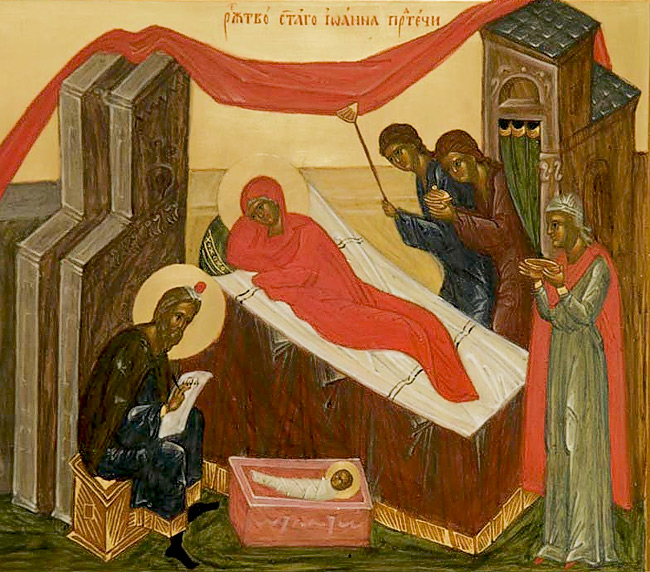
John the Baptist was born and his birth puts an end to the long silence of God. For a long time, God sent neither prophet nor prince to his people. It was as if God got fed up with the constant adultery of his people that he decided to give them the “silent treatment.” The nine month silence of Zechariah was a sign of this. Remember that Zechariah was made mute by the angel who appeared to him before John was conceived. And when the child was circumcised and was named “John”, Zechariah’s tongue was loosened. He began to speak in prophecy. At last, God speaks to his people. At last, he has sent a prophet to them. And the purpose of the sending of the prophet was to prepare the way for the coming of the Word of God himself: “You, my child, shall be called prophet of the Most High, for you will go before the Lord to prepare his way, to give his people knowledge of salvation by the forgiveness of their sins.” (Ikaw naman, sanggol, ay tatawaging propeta ng Kataas taasan, sapagkat mangunguna ka sa Panginoon upang ihanda ang kanyang daraanan, upang ituro sa kanyang bayan ang kaligtasan sa kapatawaran ng kanilang mga kasalanan.)

The birth of John was the sign that the long wait is about to end. “The night is far spent and the day draws near…” so would St. Paul say. Soon the darkness will be over. The night will give way to the dawn. The Light of the world will be born and he will dispel the darkness of error, sin, and death. And when the day comes, we shall all see what was hidden from us under the cloak of darkness. When the darkness of sin is lifted up, we shall see how beautiful the world was meant to be. We shall see how wonderful is the life that God intended to give us. On that day, we shall realize how much the devil has stolen from us and what he has deprived us of.

Dawn is the beginning of day. It is a fresh start, a new beginning. Tired and weary, we rest our bodies in sleep. We wake up fully refreshed at dawn. Whatever mistakes we have done, whatever filth we have incurred, all these will pass away together with the darkness that is dispelled by the first streaks of the light. The Lord allows us to rise to a promise. Dawn is the opportunity to start all over again.
And this is the dawn of Christmas morning. Most of us have wonderful memories of childhood Christmas mornings. I have my own. When I was a child, I woke up on Christmas mornings always with a sense of awe. I was awed by the gifts beneath the Christmas tree and by the goodies left by Santa on the socks I hang on the wall. I hope, that tomorrow, on Christmas morning, all of us will awake with child-like wonder. Let us be like wide-eyed children as we behold the gift on God beneath the Tree of the Cross: his only begotten Son who will be born of the Virgin. When you behold him, pray to him and ask him to take away your sorrows and wipe away your tears. Ask him to dispel your darkness and drive away your fears. Ask him to forgive your sins and bring you to forgive others as well. Soon, we shall see the promise of Christmas morning. Tonight, let us go to sleep with hope in our hearts. Whatever darkness you are going through, it will come to end. The dawn from on high shall break upon us!

O Mary conceived without sin, pray for us who have recourse to thee!

Simbang Gabi 2018 8: The Messenger who goes before the Lord


SIMBANG GABI 2018 8
YEAR OF THE YOUTH
DECEMBER 23, 2018
 
Jesus, I trust in you!

Advance party…this is the most appropriate description I can give of the birth of John the Baptist. If there is any significance in this birth, it is not that he was sort of a miracle baby born to aged parents. It is also not that his father’s tongue was loosened on the day of his circumcision. The significance of this birth is described by the prophet Malachi: I will send my messenger before you to prepare the way before you.”  This baby is no ordinary messenger. He was likened to the Prophet Elijah, the greatest of all the prophets. He had to come in the spirit of the greatest prophet because the one who will be born after him, the one whose path he must prepare, is the Almighty God. “Who can endure the day of his coming and who can stand at his appearance? He is like the refiner’s fire and fuller’s lye; he will sit as a refiner and a purifier. He will purify Levites like gold and silver.” Obviously, the preparation needed is more than just planning parties and banquets. It would involve much more than gifts and decorations. Because the one coming is Almighty God, preparing for him will involve purification from sin so that the worship we shall offer to him will be truly pleasing and acceptable to him.

The advanced party is now here…it only means that the Lord will follow soon. In fact, in (2) a day’s time, it will be Christmas morning. Are you prepared for it? You have probably made a list of things to do and of people to send gifts to. Have you made your list and checked them twice? But with Noche Buena and gifts prepared, can you really say that all is set? How about your soul? Are you purified enough? Have you gone to confession? Malachi said: “He shall turn the hearts of the fathers to their children, and the hearts of the children to their fathers.” Have you mended broken relationships? Mga kabataan, may atraso ba kayo sa inyong mga magulang? Nakahingi na ba kayo ng tawad? Parents, have you neglected your children? Have you made up for your neglect? Bully boy whose video went viral definitely was the product of parental neglect. For if it were not so, then how did he grow up filled with so much hatred? Obviously money is not the only element of child rearing. More important than money would be time, attention, and discipline. How is your family? Is it prepared to welcome the Lord? Are you now reconciled and at peace with each other? Perhaps, if you have been concerned with external preparations and have neglected the spiritual and relational preparations, you have the last two days to fix things and so be prepared for the Lord’s coming.

“Look up and see: your redemption is at hand.” It is only when we are spiritually prepared that we can recognize the great gift the Lord bestows upon us. And believe me…the Lord has shown us so great a favor. It will be just so sad to miss it simply because we were not prepared to see it. Ask the Lord to silence your heart so that you may hear his voice. Ask him to open your eyes so that you may recognize him who comes. Ask him to purify and humble your heart so that you may welcome him with great joy.

O Mary conceived without sin, pray for us who have recourse to thee!
Thursday, January 17, 2019

Simbang Gabi 2018 7: A Young Girl's Prophetic Song


SIMBANG GABI 2018 7
YEAR OF THE YOUTH
DECEMBER 22, 2018

Jesus, I trust in you!

The Magnificat is an impressive song which oftentimes is unappreciated because when it is sung, we seldom get past the first verse. Of course, Our Lady acknowledged that God has done mighty things for her and therefore, all generations will call her blessed. But the song is not just about what God has done for her. It was also about how God intervened into human history and inverted its paradigms: “He has shown the strength of his arm, he has scattered the proud in their conceit. He has cast down the mighty from their thrones and has lifted up the lowly. He has filled the hungry with good things and the rich he has sent away empty handed…” What is wonderful about this song is that it was sung by a 15 year old girl. Such concerns were way beyond the comprehension of a 15 year old. It was clearly inspired by the Holy Spirit himself…for how else could a 15 year old sing of these? I am of the opinion that the Magnificat is a clear reflection of the Beatitudes that were declared by our Lord himself: the Lord himself declared the blessedness of those who are accounted as negligible by the world.

A 15 year old girl singing a prophetic song…shouldn’t this be the model of our young people? The Magnificat is an invitation to all the youth to elevate their concerns beyond trivialities like fashion, gadgets, and other self-centered issues. Look around you…are you satisfied with what you see? Do you think that hunger and misery amidst a throw away culture is really right? Do you think that it is right to get your way simply because you are powerful? Apparently, the notorious bully of Ateneo thinks that his taekwondo skills gives him the right to impose himself on everybody whom he perceives is weaker than him. Is it right for a young 14 year old like him to be abusive of the little power that he and his family has? Young people, what are your concerns? Do these transcend your little world of comfort? Are you capable of going beyond yourselves so that you can see the misery of others? Say not that you are young…because the Kingdom of God is your concern. You must contribute to the building of the Kingdom of God by using what you have and who you are to make the world less miserable, less unjust, less cruel. Your youthful idealism must drive you to seek for a better world and in the end, “HUWAG KAYO PAKAKAIN SA SISTEMA.” Youthful idealism will end up meaningless if we begin to “dance with the world” by compromising principles for pay-offs or for a little bit of fame and power. Hindi lahat ng bagay ay nabibili…kasama na diyan ang prinsipyo at ang paninindigan. Hindi lahat ng nabibili ay nagpapaligaya.

Dear young people, let your idealism make you hunger and thirst, not for success, fame and fortune, but for the Kingdom of God. Be hungry for righteousness. Mourn for the prevalence of sinful structures in society. Work for justice by being just and fair. Work for peace by being peacemakers and by resisting temptations to be violent. Be compassionate to the poor. And live simply so that you can always have something to share. Huwag lang panay ang sarili ang isipin natin.
As for the mighty and powerful, balang araw, babagsak din sila. Just wait and see. The Kingdom of God, which is built with blood and sweat, this alone will remain standing for ever.

O Mary conceived without sin, pray for us who have recourse to thee!

Simbang Gabi 2018 6: Empowered by the Holy Spirit


SIMBANG GABI 2018 6
YEAR OF THE YOUTH
DECEMBER 21, 2018

Jesus, I trust in you!

Upon discovering from the angel that her elderly cousin Elizabeth was pregnant, Mary set out in haste to visit her and attend to her needs. But it was not her alone who went to visit nor was Elizabeth alone who was the object of the visit. Mary was carrying in her womb the Son of God who had just been incarnated. On the other hand, John the Baptist has been living in his mother’s womb for six months then. Mary went to visit Elizabeth. Jesus went to visit John. Mary went to visit Elizabeth to help her through a difficult pregnancy. Jesus went to visit John to sanctify him with the Holy Spirit even though he was still in his mother’s womb: “He will be filled with the Holy Spirit even from his mother’s womb,” so said the angel to Zechariah at the temple. Little did Mary realize that she was doing more than just assist her cousin for at that moment when John was sanctified in his mother’s womb, Jesus was already saving him. That moment of charity became a moment of salvation. Beneath what was visible, something invisible was wonderfully taking place.

The Holy Spirit overshadowed Mary and thus made the Incarnation possible. But let us not forget that the Holy Spirit did something more in Mary. He inspired her to go to Elizabeth. In fact, the conversation between Mary and Elizabeth was a Spirit-filled conversation. When Elizabeth heard Mary’s greeting, the baby in her womb leaped for joy and she, filled with the Holy Spirit, declared Mary’s blessedness as Mother of the Lord.

Young people, the Holy Spirit whom John received in his mother’s womb is the same Holy Spirit we received on the day we were baptized. He is the same Holy Spirit who overshadowed Mary and empowered her. Thus, you and I are empowered also by the Holy Spirit. He empowers us with his supernatural gifts. As our helper, the Holy Spirit in us empowers us to live lives that radiate the goodness of God. He helps us to be who God created (intended) us to be. He is the power who sustains, energizes, and keeps us on a holy path. The Holy Spirit makes us holy. He purifies us from our sins through the Sacrament of Confession. He helps us convert and be Christ-like. He transforms us into the image of Christ. The Holy Spirit directs and helps us to do the will of the Father. The Holy Spirit imparts to us gifts that will help us serve the Church. He empowers us to fulfill the calling God has placed on our lives. He pours on us the love of God to sustain us through difficult moments. He keeps hope alive in us through such moments by reminding us that we are constantly loved by God. He helps us pray most particularly when it seems too difficult to pray because our sorrows are too great. He reminds us of what Jesus said and taught us, especially when the trials seem to be too great. And most of all, the Holy Spirit makes us witnesses for Jesus. As the Holy Spirit pointed out to John the Baptist the hidden presence of Jesus in the womb of Mary, so also does he point out the hidden presence of Jesus to the world. This is what we testifies to us. He keeps reminding us that the Lord is near. He reveals to the world the Gospel and he does this through us. Therefore, we should not shy away from being advocates for Christ. Nor should we worry about what to say. The Holy Spirit will put these words on our lips. And those words will be powerful words. Look at what the Holy Spirit placed on the lips of Mary. It was just a greeting but when this greeting reached Elizabeth’s ears, the baby in her womb leaped for joy. Through that greeting, John was sanctified.

We are an empowered people. Baptism gave us the Holy Spirit. Let the Spirit make us go in haste to bring the Gospel to our friends and to all people. Young people, you are gifted. More than just your innate talents, you are gifted with something more. You have received the Holy Spirit. Go and share the Gospel. In the power of the Holy Spirit, be disciples. In the power of the Holy Spirit, make disciples.

O Mary conceived without sin, pray for us who have recourse to thee!

Simbang Gabi 2018 5: Open your Door to the Redeemer


SIMBANG GABI 2018 5
YEAR OF THE YOUTH
DECEMBER 20, 2018

Jesus, I trust in you!

The appointed time has come and the long wait will soon be over. It was the time for God to send his Son to redeem the world. And so, he sent the Angel Gabriel to Nazareth to a virgin who was betrothed to Joseph. And the virgin’s name was Mary. Why was the angel sent? He was sent to ask Mary for her consent to the Divine Plan that she will bear a Son who will be the Son of the Most High, the ruler of a Kingdom that will have no end. Is it not strange that God should do this? After all, He can do whatever he pleases. He can do all things. He can always have his way. What is he in power for if he could not enforce his will?

And yet, such is the humility of God. The act of becoming man is humbling in itself for God. God is almighty…the universe could not contain him. There is nothing in the universe that does not owe its existence to Him. And yet, in his desire to redeem us, God took the form of a slave, being born in our human likeness. And true enough to his self-emptying (kenosis), he politely knocks at the door of the heart of Mary. He sent his angel to plead with her: Please accept my Son…he will be sent on the mission to save the world. Allow him to take flesh from you and reside in your womb for nine months. Allow him to be nurtured and to be raised by you.

The humility of God: he comes to do us a favor. He comes to save us…and yet he still asks for Mary’s consent. In humility, he comes to Mary and through Mary, he comes to us. He did not force Mary to take him in. He did not want Mary to accept him if it were against her will. Mary enjoyed freedom of will. In the 1st reading, Ahaz was told: Ask the Lord for a sign, let it be as deep as the nether world or high as the heaven. Ahaz close to reject the offer: I will not ask…I will not tempt the Lord! Mary was allowed to express her hesitation: “How can this be, since I have no relations with a man?” The angel patiently explained to her how the Holy Spirit will overshadow her and make it possible. All she needed to do is to say “Yes!” And Mary did! She said: “Behold the Handmaid of the Lord, let it be done according to your word.” That consent, given in freedom, was the key. Through that consent, Mary’s life was changed. Through that consent, the world will never be the same. The Word was made flesh and dwelt among us!

Many young people hesitate to open their hearts to Christ. They fear that Jesus will make many demands that will curtail their freedom. They want to enjoy life and to them, it can be done only if they kept away from Jesus. But none is farther from the truth. Away from Jesus, there is no freedom…but only slavery. There is no fulfillment, but only emptiness. There is no contentment because there will always be something lacking. Why is this so? It is because God has created in our hearts a vacuum that only he can fill. God has made us for himself and our hearts will always be restless until we rest in him!

At the inauguration of the World Youth Day in Cologne, Pope Benedict dared the youth: “Dear young people, the happiness you are seeking, the happiness you have a right to enjoy, has a name and a face: it is Jesus of Nazareth, hidden in the Eucharist. Only he gives the fullness of life to humanity! With Mary, say your own ‘yes’ to God, for he wishes to give himself to you…If we let Christ into our lives, we lose nothing, absolutely nothing of what makes life free, beautiful and great. No! Only in this friendship are the doors of life opened wide. Only in this friendship is the great potential of human existence truly revealed. Only in this friendship do we experience beauty and liberation.’”  

O Mary conceived without sin, pray for us who have recourse to thee!

Simbang Gabi 2018 4: A Life of Purpose

SIMBANG GABI 2018 4
YEAR OF THE YOUTH
DECEMBER 19, 2018

Jesus, I trust in you!

Even before they were conceived and were born, both Samson and John the Baptist had a purpose for living. These were both revealed by angels to their own parents. The angel said to the mother of Samson that her son will begin the deliverance of Israel from the power of the Philistines. The angel Gabriel said to Zechariah that his son will prepare a people fit for the Lord. Samson was consecrated to God from the womb. John will be filled with the Holy Spirit even from his mother’s womb. Being consecrated to God means that a person belongs to him. This is a sign of God’s love and mercy towards the promised child and to the parents who will receive him from the Lord. Elizabeth, the wife of Zechariah, declared: “So has the Lord done for me at a time when he saw it fit to take away my disgrace before others.”

The Responsorial Psalm sings of the praises of God coming from a person who recognized the Lord’s singular love for him. “You are my hope, O Lord, my trust, O God, from my youth. On you I depend from birth; from my mother’s womb you are my strength. I will treat of the mighty works of the Lord; O God, I will tell of your singular justice. O God, you have taught me from my youth, and till the present I proclaim your wondrous deeds.” (Ikaw ang aking pag-asa, O Diyos ko; ang aking pinanaligan, Panginoon, mula pa sa aking pagkabata. Mula pa sa aking pagsilang ikaw na ang umaalalay sa akin; mula pa sa sinapupunan ng aking ina ikaw na ang aking lakas. Isasalaysay ko ang kapangyarihan ng Diyos; O Panginoon, ipapahayag ko ang katangi-tangi mong kabanalan. O Diyos, tinuruan mo ako mula pa sa aking pagkabata, at hanggang ngayon ay ipinahahayag ko pa ang iyong mga kababalaghan.) These words should be proclaimed by all people, and especially by the youth. It is because like Samson and John the Baptist, each of us were created for a life of purpose (may layunin ang buhay). We do not lead meaningless lives because God always has a reason for creating something. He does not create anything without meaning or purpose. The mere fact that we were created…the mere fact that we exist is the proof that we have a purpose for existing (may dahilan sa pamumuhay). There is always an answer for the question: Para saan ka bumabangon? Para kanino ka bumabangon?

Perhaps, for some, their purpose is not clear because they keep on looking at themselves in reference to people who do not seem to appreciate the gift of their persons. And this is sad. When we feel unappreciated, it is because we fail to see ourselves the way God looks at us. Each person is a gift. Samson was God’s gift not only the Manoah and his wife. He was God’s gift to the people of Israel who are to be delivered by him from the Philistines. John was God’s gift not only to Zechariah and Elizabeth but to the people who will be prepared by him for the Lord. You are a gift…otherwise, you will not be here on earth. One day, that purpose will be clear…you will mean something to someone because right now, you mean something to the Lord. No one is useless because God does not make trash.

Dear young people, you are beloved by God. From your mother’s womb, God called you to belong to him. Place your hope in the Lord. Trust him. Let the Lord be your strength. Let your life be one long song of thanksgiving to the Lord. You can only thank the Lord the moment you recognize that you are a gift. You are a gift of God to those who love you. You are a gift of God to the world. You are a gift of God to yourself. You did not create yourself. God did. And because of this, you have a purpose. God does not create meaningless creatures. God does not do things without a purpose.

 Mary conceived without sin, pray for us who have recourse to thee! 

Simbang Gabi 2018 3: St. Joseph and Vocation


SIMBANG GABI 2018 3
YEAR OF THE YOUTH
DECEMBER 18, 2018

JESUS, I trust in you.

In the genealogy of Jesus, St. Joseph was not called the father of Jesus. He was simply referred to as the husband of Mary who, in turn, was called the Mother of Jesus. This clearly pointed to us that Joseph was not the biological father of Jesus. The Gospel reading today tells us that when Mary was betrothed to Joseph, but before they lived together, she was found with child. In Jewish custom, a betrothal meant that a man and a woman have promised themselves to each other. The man is given a year to build their house and upon completion of the task, he goes to the house of the bride to claim her and bring her home with him. This was a beautiful custom which is unlike the co-habitation or living-in which many people do today. Today, couples live like husband and wife even without the benefit of marriage. They make a claim on each other’s persons and bodies but without asking God to seal their marital covenant. This was not the case for Joseph and Mary. They promised themselves to each other but they have not yet lived together because it was not yet the time. They had to wait for the proper time when they can consummate their marriage.

But before this could happen, Mary was found to be with child. But her pregnancy was not on account of fornication. Joseph respected Mary and protected her virginity. And Mary, on her part, was faithful to Joseph. Her pregnancy was the fruit of the action of the Holy Spirit. God had a special plan for mankind and this he intended to accomplish through Mary. St. Joseph had a dilemma. He was torn between his love for Mary and her exalted vocation. Could he keep Mary for himself or should he, out of generosity, step back quietly to allow God some space in order to accomplish his plan for her? He must have silently agonized over this problem. All he wanted was to accomplish God’s will. The Lord answered his prayer and sent the angel to convey his answer: “Do not be afraid to take Mary for your wife.” God wanted St. Joseph to be husband to Mary and also to be father to his only begotten Son. Mary will give God’s Son his flesh. Joseph will give him his name. Because of Joseph, Mary’s Son will be called “Son of David.” Joseph will make Jeremiah’s prophesy a reality: “I will raise up a righteous shoot to David; as King he will reign and govern wisely.” When God’s will was made clear to him, Joseph rose up to fulfill it. He took Mary and took her home with him as his wife.

Young people are often confronted by the question of vocation. What is the direction my life should take? Where is this leading me? Is this the right person for me? Am I called to this way of life? While there are many things to consider when making life choices, the most important consideration should be the discernment of God’s will. It is only in fulfilling God’s will where true happiness and a sense of fulfillment be found. And God’s will can only be discerned in constant prayer. It is to the praying heart that God reveals his will. When confronted by a difficult choice, do not simply ask yourself. Rather, ask God through prayer. This prayer is not a quick visit to the church for an Our Father or a Hail Mary. Rather, it is silently coming constantly before God. We should keep asking God until he makes his answer clear. St. Joseph will prove to be a reliable companion for discernment. Ask St. Joseph to help you pray to the Lord. Seek for the Lord’s enlightenment. Always bring everything to prayer.

O Mary conceived without sin, pray for us who have recourse to thee.  


Simbang Gabi 2018 2: The Lion of the Tribe of Judah


SIMBANG GABI 2018 2
YEAR OF THE YOUTH
DECEMBER 17, 2018

JESUS, I trust in you!

Advent makes a significant turn today. From being a preparation for the Lord’s 2nd coming, today it becomes a direct preparation for Christmas. And our journey towards the day of the Lord’s Nativity begins with the famous genealogy of the Lord Jesus. To many young people, the reading today may sound boring. After all, it is just a list of names of the human ancestors of the Lord. This is how it seems to be because we never made the serious effort to know the stories beyond the names. If only we made that effort, we will find out that these ancestors led very colorful and intriguing lives. Let us take Judah for example.

Jacob wanted to marry Rachel and worked for it for 7 years but later on was deceived by Lot to marry the elder sister Leah. And so, Jacob had to work for another 7 years to take the younger Rachel for his bride. Of course when they were married at last, Jacob showed preference for Rachel whom he loved more than Leah. The Lord saw this and so he favored Leah and Rachel did not bear children.  Leah bore Jacob his first 3 sons and she thought that she will be loved on account of them. But still she did not earn her husband’s love. When she gave birth to her 4th son, Leah said, “This time I will praise the Lord.” She named him “Judah” meaning “praise” or “thanksgiving.”

The Book of Genesis today tells us that Judah was destined to be great among the sons of Jacob. He was destined to be the ancestor of the Israelite kings. He rose in leadership because his 3 elder brothers were disqualified on account of sexual misconduct of Reuben and the bloody revenge by Simeon and Levi. Jacob blessed Judah in the presence of his brothers: “The sons of your father shall bow down to you…Judah crouches like a lion recumbent – the king of beasts.” The fourth son of the unloved wife will be the ancestor of King David…and later on of Jesus. Jesus was the son of David, the son of Judah, the son of Abraham.

God prepared the family to which Jesus will be born in a truly amazing way. If we look at the lives of each ancestor of the Lord, we will discover very scandalous cases. Tamar’s relation with Judah was illicit because she was his daughter-in-law. At the very root itself, we find the defects of the tree. No wonder David’s kingly line will emerge from an illicit affair with Uriah’s wife which eventually led to murder. Kung ano ang puno siya ang bunga.

If this were true of Judah and David, how could Jesus have emerged unaffected by the “sins of his fathers?” The answer is rather simple. Look at the end of the genealogy. It spoke of Joseph not as the father of Jesus but as the husband of Mary. We all know that St. Joseph was not the biological father of Jesus. He stood as the legal father of Jesus but never was he Jesus’ biological father. “Joseph was the husband of Mary. Of her was born Jesus who is called the Christ.” Jesus did not inherit the generational sins of his family. He is the seed of the woman. Jesus was born to redeem the sins of his people…but first of all the sins of his ancestors.

Sometimes we wonder why we have become what we are. It is important to look at our personal lineage (angkan). To understand ourselves, we need to look at the ancestors who came before us. Traits are inherited and so are sins and defects. (This is true even biologically as there are families that are prone to certain diseases…we always say that it runs in the family.) Sometimes, we suffer the curses incurred by our ancestors. However, we should never feel helplessly trapped in this situation. There is a way out. As Jesus cleansed his own family with his own blood, so also should we ask him to cleanse our family with his blood. With faith in our Lord and in his Blessed Mother, we must ask that the Cross be placed between us and any unhealthy relationships.

The genealogy of Jesus shows us that the Lord hails from a royal line. The Kingship of Jesus gives fulfillment to the blessing of Jacob for Judah. Jesus is the powerful King who defeats the enemy. He is the Lion of the tribe of Judah who has conquered and destroyed the work of the devil. If only we put our faith in him and have recourse to the Church which is his Kingdom of earth, we can rise from the faults of our fallen generation. Faith in Christ empowers us in this spiritual battle. Jesus is the Father’s gift to fallen humanity. In Jesus, we are beloved by God.

O Mary conceived without sin, pray for us who have recourse to thee!

Simbang Gabi 2018 1: The Winnowing Fan


SIMBANG GABI 2018
3RD SUNDAY OF ADVENT C
DECEMBER 16, 2018

Jesus, I trust in you!

The beginning of Simbang Gabi this year coincides with the 3rd Sunday of Advent which is known as the Gaudete Sunday or the Day of Rejoicing. Both occasions which coincide on the same day tell us of the same message: The Lord is near! Therefore we should rejoice. And by now, many of us feel the pressure of the approach of the holy days. Traffic is exceedingly heavy because everybody wants to do last minute Christmas shopping. After all, we are down to the last 9 days to Christmas. And also let us not forget the many Christmas parties we must attend…even if it were still only in the Advent Season. All of these constitute our preparations that we must fulfill because Christmas is near. “Now the people were filled with great expectation,” so the Gospel tells us. I suppose that these words apply to us as well.

But what are we expecting? Who are we expecting? Are we expecting gifts? Food? Liquor? The return of some long separated loved one? Reconciliation with a former friend? What is is that we are expecting? In the time of John the Baptist, people were clearly expecting the coming of the Christ. They were all asking in their hearts whether John was the Christ they were waiting for. And John was quick to say: “The one mightier than I is coming. I baptize you with water but he will baptize you with the Holy Spirit and with fire. His winnowing fan is in his hand to clear his threshing floor and to gather the wheat into the barn, but the chaff he will burn into unquenchable fire.”

The winnowing fan. Farmers know what this is all about. After the harvest, the grains are collected and pounded (bayuhin) and they are thrown before a powerful fan. The fan blows away the chaff (balat) while the grains fall to the ground. The chaff are easily blown away because they are empty. The grains are heavier, therefore these fall into the ground.

And so we, who find ourselves amidst the frenzy of holiday preparations must ask ourselves: If our preparations are thrown before the winnowing fan, will they be blown away because they are empty? Or will they fall to the ground because they are substantial and real preparations?

“What must we do?” the people asked John. So also should we ask him as well. And John answers us: share and change. “Whoever has 2 cloaks should share with the person who has none. And whoever has food should do likewise.” Isn’t this the filling of the valley that he referred to last Sunday? And to the tax collectors he said, “Stop collecting more than what is prescribed.” To the soldiers he said, “Do not practice extortion, do not falsely accuse anyone. Be satisfied with your wages.” Aren’t these the leveling of the mountains that he referred to last Sunday? By sharing what we have, no matter how little they may be, we fill up the valleys. By cutting down our sinful ways, we level the mountains. This is the substantial preparation for the Lord’s coming. “Your kindness must be known to all. The Lord is near,” said St. Paul.

As every Advent brings us closer to the end, so we should make sure that every Advent increases us in holiness and decreases us in sinfulness. Remaining unchanged from one Advent to another is a waste of so much opportunity given to us by God. Remember that as the deadline draws near, we should be progressing in the work assigned to us. The closer we get to the end, the more task we should have accomplished so that when the time is up, we have something to present, something to offer to the Lord. When we are told that the Lord is near, it means that the struggle for holiness will not be for long. Therefore, let us urge one another to go on and not to abandon the fight. The Lord is near. His recompense (kabayaran) comes with him. Soon, we shall rest from our labors. Soon, we shall be rewarded for our faithful service. It won’t take long. The Lord is near. Our salvation is at hand.

O Mary conceived without sin, pray for us who have recourse to thee!

Wednesday, December 27, 2017

Christmas Midnight Mass: Christ the Priest, the Victim, the Bread of Life

CHRISTMAS MASS AT MIDNIGHT 2017
YEAR OF THE CLERGY AND CONSECRATED PERSONS
DECEMBER 25, 2017

Jesus, I trust in you!

Our Parish Belen for 2017
Tonight we return to Bethlehem as Joseph and Mary did as they sought to comply with the worldwide census declared by Augustus Caesar. They had to return to the city of David because Joseph was of the House of David. It was necessary for the Messiah to be born in the city of David because he is Son of David, the legitimate heir to the throne of his royal ancestor. But there is another reason for the birth of Jesus in Bethlehem. The name “Bethlehem” means “house of bread.” Bethlehem is the fitting birth place for Jesus who is the Bread of Life. In fact the sign which the angels gave the shepherds was that of a baby wrapped in swaddling clothes and laying on a manger. The manger is the receptacle of animal food. On it is placed the hay for the feeding of the ox and the donkey and even of the sheep. The new-born baby of Mary was laid on a manger not because the hay was soft but because Mary’s child is our food: “I am the Bread of Life. Whoever eats my flesh and drinks my blood will have eternal life. For my flesh is real food and my blood is real drink. The food that I will give is my flesh for the life of the world.”

It is rather remarkable that we celebrate today the birth of the Son of God in the flesh. And later on, he shall give his flesh as food for the life of the world. We cannot deny the Eucharistic character of this Holy Day that we are celebrating tonight. It is called “Christmas” and its name is derived from two words: Christ and Mass. The Church, even from ancient times, has understood the mystery of Christ’s Incarnation in the mystery of the Eucharist. In fact, St. John Paul II himself said that the Eucharist is the continuation of the mystery of the Incarnation to our times.

And it is in this light that we have a renewed appreciation of the mystery of the Priesthood. We are celebrating this Christmas in the Year of the Clergy and the Consecrated People. As Mary brought forth the birth in the flesh of God the Son, so also the priest, by the power of the Holy Spirit and the authority of the words of Christ, brings about the transubstantiation of bread and wine into the Body and Blood of Jesus. The Mass, presided by the priest, is not only our encounter with the Paschal Mystery. It is also our encounter with the mystery of the Incarnation: And the Word was made flesh, and dwelt among us. The Incarnation took place in Mary’s womb. The Transubstantiation takes place in the hands of the priest. The priest may not be as pure and sinless as the Virgin Mary. But nevertheless, the Son of God humbles himself to take flesh in the bread and wine offered on the altar during Mass.

In fact, we cannot miss the fact that the angels appeared to shepherds who were keeping watch over their flock at night. The sheep they were tending were the Awassi sheep, the only breed of sheep that is indigenous in Israel. The Awassi sheep breed in the summer and drop lambs in the winter. Thus, in Israel, the principal lambing season runs from December to January. These shepherds to whom the angels appeared were Levitical shepherds who were tasked to keep watch over the temple flock. The reason why the shepherds kept watch at night was that they were attending to the dropping of the lambs. Once a lamb is dropped, they bring it into the cave where it is wrapped in swaddling clothes to keep it from being injured at birth. The lambs they watch over were destined to be the Passover lambs that are supposed to be unblemished. Thus, the shepherds understood what the angel’s message meant: the one born on this night is the unblemished Lamb of God who would be sacrificed on Passover. Christ born today is not only the Bread of Life. He is also the Paschal Lamb, the Victim who would render God the most perfect and the highest act of worship. This Lamb of God is also the High Priest of the new covenant. Being the first-born of creation, he is the head of the household who offers the sacrifice of the family of humankind. He will offer not the blood of animals or of other human beings. He will offer his own flesh and his own blood for the redemption of the world.

As we celebrate the birth of Jesus, let us not look at him simply as a cute new-born infant. The one who rests on the manger is the Bread of Life. The one who is wrapped in swaddling clothes is the unblemished Lamb of God. The first-born of Mary is the first-born of creation, the High Priest of the new covenant. This great mystery is renewed every day during Mass. In the Mass, the priest acts in the person of Christ the High Priest. In his hands the incarnation takes place so that the Lamb of God may be offered to the Father and he be returned to us as the Bread of Life that we must eat to enter into communion with God and so receive access to the Divine Life. Truly, this is Christ’s Mass where Jesus comes both as Priest and Victim. Come, let us adore him.   


O Mary conceived without sin, pray for us who have recourse to thee!

Simbang Gabi 9: The Priest as Herald of the world to come

SIMBANG GABI 2017 9
YEAR OF THE CLERGY AND CONSECRATED PERSONS
DECEMER 24, 2017
 
Jesus, I trust in you!

On the last day of the Simbang Gabi, we hear Zechariah’s song of praise. Remember that he was silenced for 9 months and on the day of the circumcision of his newly born son, his mouth was opened, his tongue loosed, and he began singing the praises of God. His is a fitting song because it was basically about the end of the night of waiting and the coming of the dawn: “In the tender compassion of our God, the dawn from on high shall break upon us to shine on those who dwell in darkness and the shadow of death and to guide our feet into the way of peace.”
Every Advent, St. Paul reminds us that “The hour has come for you to wake up from your slumber, for our salvation is nearer now than when we first believed. The night is far spent; the day draws near. So let us lay aside the deeds of darkness and put on the armor of light.” (Rom 13:11-12) He compared the time of waiting to night and the coming of salvation to the drawing near of the day. And every Advent brings us closer to that promised day. Zechariah ends our Advent journey by referring to the dawn from on high breaking upon us. He recognized that his son, John the Baptist, is the one “who will go before the Lord to prepare his way.” He could almost see the end of the long wait. His son is the precursor and he prepares the way of the one who is sure to follow. The Dawn of Salvation is so close. He is sure to come.

The Precursor of the Lord
This is the witness of John to the coming of the Lord. The priest also gives witness to the same coming of the Lord. He points out the nearness of salvation. Not only does the priest bring Christ closer to people by making him present in the preaching of the word and the celebration of the sacraments, he himself gives witness to the world about the coming end…the day of the resurrection. Leaving his biological family, the priest puts himself in the service of the family of God. His celibacy does not only provide the availability that he needs to fully serve the kingdom. His celibacy is also the sign of the world to come where men and women no longer will marry not be given to marriage because they will be like the angels. His priestly service will be the only one that remains in heaven. In the afterlife, doctors, soldiers, architects, engineers, teachers and other professions will no longer be needed. There is only one thing that we shall do in heaven and that is to worship God for all eternity. That is why Christ’s priesthood is an eternal priesthood. It is one that does not cease on earth but rather in continues in heaven for all eternity.

It is when the priest comes to anoint the sick and to minister to the dying that he clearly becomes a herald of the nearness of the dawn. Oftentimes, people are afraid of calling for a priest because they mistakenly think that the priest is the bringer of death. The priest is not the bringer of death because whether he comes or not, death will come upon a person if his time is already up. The priest comes with the consolation of the sacraments. He provides for the dying person the spiritual helps he needs as he prepares for his final battle on earth. Remember that Satan wants the dying person’s soul. That is why he uses all the tricks and deceptions in his book in order to instill in a person some sense of despair, some thought that he cannot be saved. That is why a person’s greatest battle will be the hour of his death. This is the reason why the ministry of the priest is very important at that moment. The priest comes in the name of Christ. He provides for the dying the forgiveness of sins and also the help of the Holy Spirit so that the person might remain steadfast in his faith in Jesus. The priest is not the bringer of death. Rather, he is the bringer of hope. He is the bringer of mercy. He is the bringer of strength in that moment of great spiritual distress. When a priest ministers to the dying, he is like Zechariah who says: In the tender compassion of our God, the dawn from on high shall break upon us. He, who is ministered to by a priest, will surely close his eyes in this world and will open then in the next, in the world of the eternal day. He need not fear the night of death because the sacraments will make sure that the eternal day will come.

O Mary conceived without sin, pray for us who have recourse to thee!


Simbang Gabi 8: The Priest as Minister of the Word

SIMBANG GABI 2017 8
YEAR OF THE CLERGY AND CONSECRATED PERSONS
DECEMBER 23, 2017

Jesus, I trust in you!

When the angel Gabriel announced to Zechariah the birth of John the Baptist, he had difficulty believing in it. Thus, he was made speechless, unable to talk until the day of the fulfillment of the words of the angel. And so, he spent 9 months in silence. Deprived of voice, Zechariah experienced what the prophets of old lamented in the past: “We have in our day no prince, prophet, or leader, no burnt offering, sacrifice, oblation, or incense, no place to offer first fruits, to find favor with you.” (Daniel 3:38) The silence of the Lord was a deafening silence.

It was at the circumcision of John when the silence ended. Asked about the name of the child, Zechariah wrote: His name is John. “And immediately his mouth was opened, his tongue freed, and he spoke blessing God.” The birth of John brought about not just the end of the silence of Zechariah but also the end of the silence of God. At last, a prophet was sent. And the one who was born was not just a prophet. He is the voice in the wilderness who would declare: “Prepare the way of the Lord.” The voice is born. The Word will follow soon.

The birth of John the Baptist gives us the occasion to speak about the Priest as the Minister of the Word. “The People of God is formed into one in the first place by the Word of the Living God, which is quite rightly sought from the mouth of priests. For since nobody can be saved who has not first believed, it is the first task of priests as co-workers of the bishop, to preach the Gospel to all men.” (Presbyterorum Ordinis, 4.) The first task of priests is to preach the Word of God. The priest is ordained to preach. He carries out the mandate which Christ gave to the apostles: “Go to all the world and preach the Gospel to all creatures.” This task is vital for the Church. “By the saving Word of God, faith is aroused in the hearts of unbelievers and is nourished in the hearts of believers. By this faith, the congregation of believers begins and grows according to the saying of the Apostle: ‘Faith comes from what is heard, and what is heard comes from the preaching of Christ.’ (Rom. 10:17) ” (PO, 4.)

Thus, it is important that priests share the Gospel to everybody. “Whether by having their conversation heard among the gentiles they lead people to glorify God, or by openly preaching proclaim the mystery of Christ to unbelievers, or teach the Christian message or explain the Church’s doctrine, or endeavor to treat of contemporary problems in the light of Christ’s teachings – in every case, their role is to teach not their own wisdom but the Word of God and to issue an urgent motivation to all men to conversion and to holiness.” (PO, 4.) Like John the Baptist, the priest is just the voice. He is not the Word. The only Word is Christ. He speaks not in his own name. He repeats the words of Jesus himself: “The word that I speak is not mine but of the one who sent me.”

Because the word he speaks is not his but of the One who sent him, the priest “ought first of all to develop a great and personal familiarity with the word of God…He needs to approach the word with a docile and prayerful heart so that it may penetrate his thoughts and feelings and bring about a new outlook in him…Nor should (he) forget that ‘the greater or lesser degree of the holiness of the minister has a real effect on the proclamation of the word.’ As St. Paul said: ‘we speak, not to please men but to please God who tests our hearts’ (1 Thess. 2:4). If we have a lively desire to be the first to hear the word which we must preach, this will surely be communicated to God’s faithful people, for ‘out of the abundance of the heart, the mouth speaks.’ (Mt. 12:34)” (Pope Francis, Evangelii Gaudium, 149.)

Thus, the priest must be a man of the word of God. He is, first of all, an obedient listener and then an ardent proclaimer. He is the voice and not the Word. He is its servant and not its master. Like Zechariah, the priest must open his mouth and speak the praises of God.


O Mary conceived without sin, pray for us who have recourse to thee!  

Simbang Gabi 7: The Priest and the Church of the Poor

SIMBANG GABI 2017
YEAR OF THE CLERGY AND CONSECRATED PEOPLE
DECEMBER 22, 2017

Jesus, I trust in you!

Elizabeth called Mary blessed because she believed that everything told to her by the Lord would be fulfilled. Mary’s response was a song that the Holy Spirit inspired her to sing. In this song, she acknowledged the greatness of the Lord who looked upon her with great kindness. Elizabeth’s praise is the first of so many people who would call her blessed simply because the Almighty has done great things for her.

However, Mary’s song goes beyond thanking God for favors she personally received from him. She recognized how God is now moving in order to bring about the renewal of the entire created world. She sings of God’s mercy inverting the established worldly order: the proud being scattered in their conceit; the mighty being cast down from their throne and the lowly being lifted up; the hungry being filled with good things and the rich being sent away empty…This inversion of the world order is the breaking in of the Kingdom of God in the world. Wherever the gospel is preached to the poor, wherever the brokenhearted are healed, wherever the oppressed and the prisoners are freed, the Kingdom of God is found. The Kingdom of God is the gathering of people around Christ so that they may share in his Divine life. In this gathering of believers, Christ’s law of charity, justice and mercy is lived out.

The priest plays an important role in establishing on earth the Kingdom of God. “Priests exercise the function of Christ as Pastor and Head in proportion of their share in authority. In the name of the bishop, they gather the family of God as a brotherhood endowed with the spirit of unity and lead it in Christ through the Spirit to God the Father. For the exercise of this ministry, a spiritual power is given them, a power whose purpose is to build up.” (Presbyterorum Ordinis, 6.) The work of the priest is to gather and build up the family of God. He builds the kingdom of Christ by treating everybody with great kindness and by acting towards people according to the demands of Christian doctrine and life: “Be urgent in season and out of season, convince (manghikayat), rebuke (magsaway), and exhort (magpayo), be unfailing in patience and in teaching.” (2 Tim 4:2) His work is to educate people to reach Christian maturity: “Christians must be trained so as not to live only for themselves. Rather, according to the demands of the new law of charity, every man as he has received grace, ought to minister it one to another, and in this way all should carry out their duties in a Christian way in the service of their fellow men.” (PO, 6.)

“Although priests owe service to everybody the poor and the weaker ones have been committed to their care in a special way. It was with these that the Lord himself associated, and the preaching of the Gospel to them is given as a sign of his messianic mission.” (PO, 6.) The Magnificat is fulfilled not through an armed struggle or a class war. It is fulfilled in the exercise of charity, of mercy, and of justice. The inversion of the world order takes place through conversion – the conversion of the Church so that it may be a church for the poor. Pope Francis said: “I want a Church which is poor and for the poor.” (Evangelii Gaudium, 198.) The priest not only leads the community in works of charity for the poor. He must also allow the poor to be evangelizers themselves.  “We need to let ourselves be evangelized by (the poor). The new evangelization is an invitation to acknowledge the saving power at work in their lives and to put them at the center of the Church’s pilgrim way. We are called to find Christ in them, to lend our voices to their causes, but also to be their friends, to listen to them, to speak for them, and to embrace the mysterious wisdom which God wishes to share with us through them.” (EG, 198.)


O Mary conceived without sin, pray for us who have recourse to thee!