Sunday, January 30, 2011

When Religious Festivals Deteriorate


Another interesting article from the Philippine Daily Inquirer:

What is wrong with Dinagyang? Ask Edwin Duero - INQUIRER.net, Philippine News for Filipinos


"'The religiosity of the festival has long been in decrescendo,' he says. 'Just look at how they handle the image of the Santo Niño in their performances. May ginanunu sa siya, sa taming, sa bola, sa mais, sa bangkaw; bisan halu nagalu-ad sang Santo Niño [Some thrust it to the chair, to the shield, to the football, to the ear of corn, to the spear; even the monitor lizard is spitting a Santo Niño icon]—just because it’s a requirement of the choreography.'

His suggestion to give the Holy Child its pride of place—such as holding a procession bearing the image from church to church, or mounting an exhibit of antique Santo Niño icons—has been ignored by organizers.

To see how commercialization and tourism have secularized the Queen Festival of the Philippines and pushed its original religious devotion down the drain, one only has to listen to what the merrymakers are shouting the loudest in the streets. While they are shouting 'Viva Señor Santo Niño!' in the Ati-atihan and 'Pit Señor!' in the Sinulog, in the Dinagyang it is 'Hala bira!'

Dancing for Vocation Promotion

An interesting article from the Philippine Daily Inquirer (Monday, January 31, 2011):


BAGUIO CITY—Never too old for “Toyang.”

Catholic nuns on Saturday night danced to this Eraserheads hit inside Baguio Cathedral as part of a vocational drive to recruit new blood.

“There is a dwindling [number] of [entrants] through the years. But because of this, we might be able to get recruits,” Sr. Eva Vargas of the Villa Milagrosa Convent told the Inquirer.

About 30 nuns, aged between 25 and 80 years and who came from different Catholic congregations, danced at the altar before more than 100 churchgoers to the tune of “Toyang,” a hit among the youth in the 1990s.

The song, released in 1993 by the band Eraserheads, talked about a young man’s wish to be with a simple girl.

Joining the nuns was a group of actors who depicted how parents instill values among their children.

“The family is beset with problems. We think that discussion about vocation should start in the family,” Vargas said.

New members needed

She said they wanted to reach out to young women so the program would be brought to the city’s Catholic parishes and universities.

“We danced to ‘Toyang’ because the song is very popular among the youth. This will call their attention,” Vargas said.

The nuns also danced to “I Will Follow Him,” which became a household tune courtesy of the 1992 Whoopi Goldberg starrer “Sister Act,” to Abba’s “I Have a Dream,” and “Our Mission,” a composition by Fr. Carlo Magno Marcelo of the San Carlos Seminary here.
Vargas said 10 more performances were scheduled in Catholic churches and universities here until Feb. 7. The nuns will be joined by child performers and dancers as they tour the community.

Sr. Alice Lansang, chair of the Association of Women Religious (Baguio-Benguet), said local churches needed new staff members and missionaries.

“The city has 19 congregations of religious women, which have 95 members. [Most are] elderly and retired [nuns] … Schools, retreat houses and parishes are understaffed,” Lansang said.

Another calling

Vargas said through their campaign, the nuns also wanted to clear misconceptions toward their vocation.

“The sisters are not just there to pray in church. We can still be ourselves. Through dancing we can show the people that the life of sisters [is also fun],” she said.

She said women could choose to stay single and focus their lives on serving God and their community.

Vargas said many young people only thought about getting married.

“But there is also another kind of calling, which is the religious life, giving up a part of themselves for God,” she said.


Follow the Link: Nuns dance to get recruits in Baguio City - INQUIRER.net, Philippine News for Filipinos

I find it strange that nuns should resort to dancing to the tune of a pop song in order to recruit new vocations. Even more strange is that they did it in front of the altar of the Cathedral. The objective for them was very simple: “The sisters are not just there to pray in church. We can still be ourselves. Through dancing we can show the people that the life of sisters [is also fun].”

The good sister seemed to give us the impression that when sisters pray in church, they are not themselves. It is sad that even sisters think that praying in church is no longer attractive for the young. Thus, they danced in order to show people that the religious life is also fun.

First of all, young people are attracted to the religious vocation not because they think it is fun but because they think it is different. The religious life has something which other institutions cannot offer. Our error is really working on the impression that if the religious life is shown as no different from other professions, it would attract other young people. Dancing nuns and singing priests are shallow attempts to attract vocations to the religious life and to the priesthood. They do not appeal to the idealism of the young. Heroes and Saints make truly lasting impressions on the young. It is when the young are shown the sacredness of the religious life that they are attracted to it. A return to the sense of the sacred is the real vocation promotion. Look at the statistics of traditional religious orders. They speak for themselves.

Religious life as giving part of the themselves to God? I always thought it was all or nothing!

Oh! "Toyang" is not an appropriate song for nuns to dance to (if they want to attract vocations): Read the lyrics and judge for yourself:


They try to tell us where too young
Too young to really be in love
Refrain:
Bahay namin maliit lamang
Pero pero pero malinis 'to pati sa kusina
Kumain man kami laging sama-sama
Pen-pen-pen de sarapen
De kutsilyo de almasen
Haw-haw-haw de karabaw
De karabaw de batuten
Pengeng singko pambilbi ng puto
Sa mga tindera ng bitsu-bitsu
Skyflakes,coke 500 pahingi ng kiss
Pambayad mo sa jeepney kulang pa ng diyes
Chorus:
Mahal ko si Toyang
'pagkat siya'y simple lamang
Kahit namumrublema
Basta't kami ay magkasama
Madalas man kaming walang pera
Makita lang ang kislap ng kanyang mga mata
Ako ay busog na
At nakatambay kami sa Tandang Sora
Ti ayat ti masya nga baro
Ken balasang nataina
Uray man uray man uray man
Haan unay nga nadonya
(repeat refrain chorus)

The nuns are not listening to the music they danced to!

Saturday, January 29, 2011

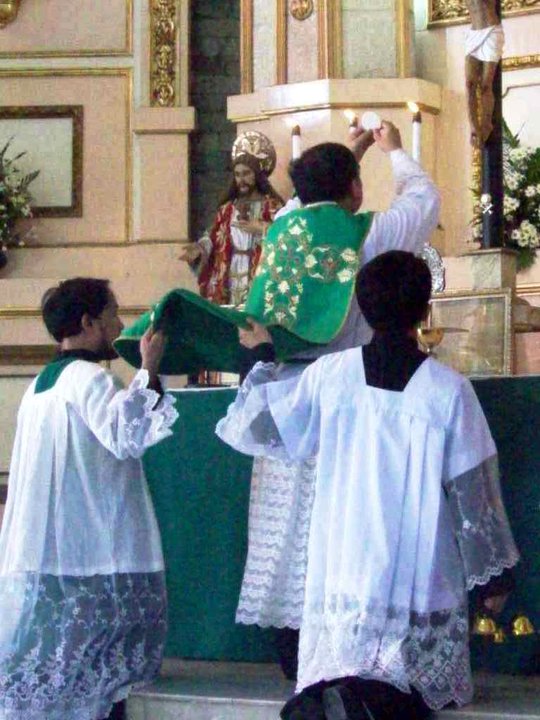
Televised Mass in the Extraordinary Form


This was our first attempt at having the Extraordinary Form of the Roman Rite aired over national television in the Philippines last Sunday, January 23, 2011. The telecast hopefully made many people aware of the existence of this legitimate alternative to the Ordinary Form of the Roman Mass. So far, we have been receiving good feedbacks. The televised Mass was that of the 3rd Sunday after Epiphany.
Thanks to Emmanuel TV for making this happen. Thanks to Jesson Allerite for the pictures.


Monday, January 24, 2011

Conversion of Persecuted Christians to Islam


"At least 20 to 25 former Christians adopt Islam each week by pledging an oath and signing a green and white document in which they accept Islam as 'the most beautiful religion' and promise to 'remain in the religion of Islam for the rest of my life, acknowledging that blessings are only from God.'

"Human rights advocates say it’s no surprise some of Pakistan’s 3 million Christians are adopting Islam. These are vexing and dangerous days for the country’s religious minorities. "


A disturbing report indeed! Let us pray to Our Lady of Good Success for persecuted Christians!


Follow the link: TheStar Some Christians in Pakistan convert fear into safety

Sunday, January 23, 2011

40th days of Christmas and Easter


"For Christ did not enter into a sanctuary made by hands, a copy of the true one, but heaven itself, that he might now appear before God on our behalf..." (Hebrews 9:24)


The novena in preparation for the Feast of the Presentation of the Lord and the Purification of our Lady begins. With this novena, we prepare to end the extended celebration of Christmas. I could not help but notice the parallelism between the 40th day of Christmas and the 40th day of Easter. On the 40th day of Christmas, the Child Jesus entered the temple. On the 40th day of Easter, the Christ entered into Heaven which is the true sanctuary which was copied by the Temple. On the 40th day of Christmas, the Child Jesus was brought into the Temple to be presented to the Lord. On the 40th day of Easter, Jesus entered Heaven so "that he might appear before God on our behalf."

Thursday, January 20, 2011

On the Organic Restoration of the Sacred


How will the mutual enrichment of the Ordinary Form and the Extraordinary Form take place? Fr. Christopher Smith posted this interesting article in The Chant Cafe:


"But I do wonder if there could not be three possible stages to the Mutual Enrichment and Reform of the Reform, and so I outline what that might look like here. I offer no timeline to this little fantasy, and I have no illusions that this discussion will go beyond the loyal readers of this blog. But here it is. Discuss.

First Stage of Mutual Enrichment

In this first stage, I see that there are many things that can be done now with no mixing of or change to the Ordinary and Extraordinary Forms of the Roman Rite as currently found in the liturgical books. I also envision some guidance from the Magisterium to point this mutual enrichment in the right direction so as to avoid arbitrariness and to give those priests who respond to the call to mutual enrichment support.

Enrichment of the Ordinary Form by the Extraordinary Form
- Bishops in Cathedrals and Pastors in their churches spontaneously adopting the ad orientem position at Mass as implicit in the OF after sustained catechesis of the faithful
- Reconstruction of altar rails in churches and the spontaneous use of the communion rail as a place from which to distribute Holy Communion
- Catechesis from the pulpit about the Church’s preference for Holy Communion on the tongue and under one species
- Move towards singing the Ordinary of the Mass in Latin at OF Masses
- Priests, on their own, choosing the options of the OF which are analogous to the EF, and leaving aside those which are not
- The spontaneous and consistent use by the clergy of the maniple, biretta, amice
- Singing of the Propers according to the Graduale Romanum at Sung Masses
- Enforcement of the ecclesiastical discipline on extraordinary ministers of Holy Communion

Enrichment of the Extraordinary Form by the Ordinary Form
- Celebration of at least one EF Mass as part of the ordinary Sunday Mass schedule by clergy trained to do it in their parishes.
- Use of the readings in the vernacular at Low Masses
- Recitation of the parts pertinent to the faithful
- Use of new prefaces and new saints’ Masses in the EF.

Magisterial Involvement
- document by the Congregations for Divine Worship and Doctrine of the Faith clarifying the Church’s teaching and discipline on the reception of Holy Communion, indicating the preference for the Church’s traditional mode of reception. In the same document, a clarification of the right of the priest to celebrate Mass ad orientem.

Second Stage of Reform of the Reform

In this second stage, the Magisterium would change the existing relevant liturgical and canonical legislation as well as provide new editions of the OF and EF Missals.

Papal Encyclical and Disciplinary Norms
The Reform of the Reform would be ushered into being by a papal encyclical, the Mediator Dei of our time. This encyclical would present a rich theology of the liturgy, a frank and honest reappraisal of post-Vatican II liturgical praxis, and a liturgical, historical, theological and canonical explanation of the following: the two forms of the Roman Rite and their mutual enrichment, the ad orientem position of celebration at the altar, the traditional mode for the reception of Holy Communion, Latin and sacred music. This encyclical would strongly encourage in an optional but clear way all of the points of the Reform of the Reform. This would be followed, after consultation with the entire hierarchy in a special synod on the Reform of the Reform, disciplinary norms which would indicate the normative status of each of the points of the Reform of the Reform.

Restoration of the Subdiaconate and the Revisiting of Pontificalis Domus
The disciplinary norms would include the restoration of the ancient subdiaconate to the life of the Church put in abeyance by Paul VI’s Ministeria Quaedam. It would also revisit the simplifications in Paul VI’s Pontificalis Domus concerning the costume of prelates to allow greater freedom for hierarchical dress.

Norms on Church Construction
Issuance by the Congregation for Divine Worship of practical guidelines for the building of new churches and the fabrication of new linens, vestments and vessels with accompanying theological and spiritual commentary (d’apres St Robert Bellarmine’s works on church construction).

The Reform of the Reform Edition of the OF Missal after the Encyclical
- dropping the options which are rarely used, streamlining of remaining options
- all editions of the Missal would be bilingual
- all editions of the Lectionary would be bilingual
- addition of a new Ritus Servandus with more detailed rubrics for the ceremonies
- the addition of the EF Prayers at the Foot of the Altar, Offertory Prayers and Last Gospel as an option in the OF
- restoration of the genuflection at the Creed and before the elevations in the OF
- restoration of some feasts from EF
- integration of Orations from the EF as options
- issuance of a Caeremoniale Presbyterorum from the Papal Household in a companion volume to the Missal
- integration of the Offertory Antiphons from the EF
- making the Prayer of the Faithful optional
- substantial restoration of the EF Kalendar to the OF
- integration of the EF Lectionary as an optional cycle of the OF

The Reform of the Reform Edition of the EF Missal after the Enyclical
- all editions would include the Readings, Antiphons and Orations in the vernacular as an option.
- permission for Holy Communion by intinction
- option for the pre-1955 Holy Week Rites
- addition of OF saints’ feasts not present in EF Missal as optional
- addition of some OF Prefaces
- option to omit the Prayers at the Foot of the Altar and the Last Gospel
- composition of vernacular graduals for the antiphons for optional use
- option for the use of the OF Lectionary at Low Masses
- option for the distibution of Holy Communion by ordained subdeacons

Third Stage of the Missal of Benedict XVI, Pope of the Sacred Liturgy

This third stage would take place after the Reform of the Reform has been in place for some time and the Roman Curia, together with the world episcopate, can look into the feasibility of a once again united form of the Roman liturgy. With some distance from the post-Vatican II reforms and the lived experience of the Reform of the Reform, the Magisterium of the Church could ostensibly distill the organic development of the liturgy from its restoration and renewal into one Roman Rite again.

Is this a do-able Game Plan?
Let it be said from the beginning, that I am perfectly fine with celebrating the Missal of St Pius V in toto and the Missal of Paul VI as the occasion warrants. I do recognize, however, that flexibility in rubrics, calendars and rites, Communion under both species and the vernacular are among those things that Vatican II called for. Could they be allowed in the EF in an optional way so as to open the riches of the EF liturgy to more people? Also, the OF could easily be influenced by many of the prayers and ceremonies of the EF if that influence is tutelaged well by the Magisterium. But if priests attempt any of this on their own, they risk making the liturgy into an eccentric celebration of their opinion on how they think Mass should be celebrated. Because so much of the post-Vatican II Reform was imposed inorganically by arbitrary decisions of clergy and by officialdom, the Mutual Enrichment and Reform of the Reform also has to happen by the leadership of the clergy united with the Holy Father and the Roman Curia in collaboration with the world episcopate. Then, the organic process of liturgical development can begin again, and the future will be less charged with everyone making their own opinions into the standard of liturgical celebration. "


Follow the Link: On the Organic Restoration of the Sacred

Wednesday, January 19, 2011

Bishop Athanasius Schneider on the hermeneutic of discontinuity

"The characteristic of the rupture in the interpretation of the conciliar texts is manifested in a more stereotypical and widespread way in the thesis of an anthropocentric, secularist, or naturalistic shift of Vatican Council II with respect to the previous ecclesial tradition. . .

"One interpretation of rupture of lighter doctrinal weight has been manifested in the pastoral-liturgical field. One might mention in this regard the decline of the sacred and sublime character of the liturgy, and the introduction of more anthropocentric elements of expression.

"This phenomenon can be seen in three liturgical practices that are fairly well known and widespread in almost all the parishes of the Catholic sphere: the almost complete disappearance of the use of the Latin language, the reception of the Eucharistic body of Christ directly in the hand while standing, and the celebration of the Eucharistic sacrifice in the modality of a closed circle in which priest and people are constantly looking at each other.

"This way of praying – without everyone facing the same direction, which is a more natural corporal and symbolic expression with respect to the truth of everyone being oriented toward God in public worship – contradicts the practice that Jesus himself and his apostles observed in public prayer, both in the temple and in the synagogue. It also contradicts the unanimous testimony of the Fathers and of all the subsequent tradition of the Eastern and Western Church.

"These three pastoral and liturgical practices glaringly at odds with the law of prayer maintained by generations of the Catholic faithful for at least one millennium find no support in the conciliar texts, and even contradict both a specific text of the Council (on the Latin language: cf. "Sacrosanctum Concilium," 36 and 54) and the "mens," the true intention of the conciliar Fathers, as can be seen in the proceedings of the Council.
Bishop Athanasius Schneider
Auxiliary of Karaganda
December 2010


Follow the link: An Excerpt from Bishop Athanasius Schneider