Sunday, September 22, 2013

Joy at being found

Praised be Jesus, Mary, and Joseph.

When the tax collectors and sinners were drawing near to listen to Jesus, the Pharisees and scribes began to complain: “This man welcomes sinners and eats with them.” The response of Jesus to this complaints are three parables that end with the same refrain: “Rejoice with me because I have found my lost sheep;” “Rejoice with me because I have found the coin that I lost;“ and “We must celebrate and rejoice, because your brother was dead and has come back to life again; he was lost and has been found.” Through these parables, the Lord reveals to us that the reaction of the truly righteous to the return of sinners to the Lord should not be complaint but rejoicing. The Pharisees and scribes who enjoyed the reputation of righteousness amongst the Jewish circles complained upon seeing that sinners were drawing near to Jesus to listen to him. But the angels in heaven rejoice over the repentance of one sinner.

In fact, the repentance of a sinner should be cause for joy because it is the evidence of God’s search for us who were lost. Oftentimes we think that repentance is the result of a person’s search for God. The parables of the Lord tell us otherwise. Repentance is the result of God’s search for us. The sheep, once it discovers that it has gone astray, lays down helplessly and waits for its doom. The coin that rolls beneath furniture stays put and gathers dust. The wayward son sits in the pig sty and waits to be offered the pods on which the pigs are fed. Sinners return to God not because they found the Lord but because they were found by Him. Repentance is a sheer act of grace. And so, the repentance of sinners should be for us a cause for rejoicing because none of us would be here if the Lord had not searched for us.

St. Paul had nothing but gratitude towards the Lord Jesus because in spite of what his wayward life, the Lord called him into divine service: “I was once a blasphemer and a persecutor and arrogant, but I have been mercifully treated because I acted out of ignorance in my unbelief.” Isn’t this our common experience? Are we not all here because each of us has been mercifully treated by the Lord? If we have been found righteous, it is not because we have never gone astray for “all men have sinned and have been deprived of the glory of God.” If we are found trustworthy, it is because God searched for us and found us. And this is why we are all here. We are grateful that the Lord did not annihilate us on account of our sins. We are grateful that we have been mercifully treated by the Lord. “Therefore, as we celebrate the memorial of his Death and Resurrection, we offer you, Lord, the Bread of life and the Chalice of salvation, giving thanks that you have held us worthy to be in your presence and minister to you.” (Kami’y nagpapasalamat dahil kami’y iyong minarapat na tumayo sa harap mo para maglingkod sa iyo.) We do not gather here to flaunt our holiness. We gather here to show our gratitude: “I am grateful to him who has strengthened me, Christ Jesus our Lord, because he considered me trustworthy in appointing me to the ministry.” This Eucharist is our thanksgiving for once we were lost but now are found. We were blind but now we see.


Jesus, I trust in you. O Mary conceived without sin, pray for us who have recourse to thee!

Dishonest Wealth vs. True Wealth

Praised be Jesus, Mary, and Joseph.

When the Lord spoke of “dishonest wealth”, many of us might immediately think of material things that were acquired dishonestly – something very similar to ill gotten wealth obtained through the misuse of public funds. “Dishonest wealth” may be taken to mean misappropriated funds – funds that were supposed to help the poor but ended up into the pockets of the rich. However, “dishonest wealth” cannot be limited only to wealth obtained at the expense of the poor.

Christ is the only true treasure
Notice that the Lord speaks of “dishonest wealth” as referring to all kinds of material goods, whether they be obtained honestly or dishonestly. All material wealth is dishonest because such deceive us into some false sense of security. We have always been taught that the possession of material wealth gives us security in life. Thus, the more we accumulate, the more secured our lives are. The more we possess, the greater our capability to address our material needs like food, clothes, shelter, medicine, education, and the like. The more possessions we have the more secure our future becomes. This is the illusion that material things give us.

Such illusion ends at the moment of death. At that moment, we realize that money cannot buy us a second more of life on earth. We then will realize that money cannot be taken beyond the grave. There is no way to transfer account from this world to the other world. In other words, there is a limit to the power of money. It perishes together with this material world. And yet, the Lord says: “If you are not trustworthy with dishonest wealth, who will trust you with true wealth?” In speaking of “true wealth” the Lord is referring to the treasures of the Kingdom of heaven where rust does not corrode, moth cannot destroy and thieves cannot steal. The test for trustworthiness with regards the true and lasting treasures of heaven is the way we exercise our stewardship of the dishonest wealth of earth. The test for our loyalty and worship of God is the way we deal with mammon. Do we subjugate mammon and use material wealth to promote the work of God or do we simply accumulate material wealth and end up being used by mammon? Do we love money and use people or do we love people and use money? I think that the right thing to do is to love people and use money. We use money to help people. We do not use people to accumulate money. The Prophet Amos has a very stern warning to those who enrich themselves at the expense of the poor: “You who trample upon the needy and destroy the poor of the land…The Lord has sworn by the pride of Jacob: Never will I forget a thing they have done.”

And so, let us not be overcome by greed. Rather, let our dealings with the goods of the earth be governed by charity. Remember that we are only stewards and not owners. The earth and everything in it belongs to God. Whatever we have does not belong to us…it belongs to God. “If you are not trustworthy with what belongs to another, who will give you what is yours?” Remember that the Lord intends to give us the inheritance of heaven, only if we be faithful stewards of the things of the earth. There can be no double loyalties. You cannot serve two masters. You cannot serve both God and mammon.

Jesus, I trust in you. O Mary conceived without sin, pray for us who have recourse to thee.


Monday, September 9, 2013

Late Posting 21st Sunday in Ordinary time C :The Narrow Gate

Praised be Jesus, Mary, and Joseph!

We have always known the Lord Jesus as someone who is welcoming – someone whose heart is always willing to accommodate everybody…one who keeps telling people: “I come to gather nations of every language; they shall come and see my glory.” This is why we would wonder why he would say: “Strive to enter the narrow gate.” Is it not true that if the Lord wanted to bring all men to salvation, then he should make heaven’s gate wide and open? Then why is he saying that heaven’s gate is a narrow one?
The Lord tells us that heaven is for the strong: “Many will attempt to enter but will not be strong enough.” However, strength here is not gained by simply eating and drinking in the company of the Lord. Nor is it gained by simply listening to the Lord as he preached in our streets. For “not everyone who calls out ‘Lord! Lord!’ will enter into the kingdom of God!” The strength to enter through the narrow gate is gained by what the second reading calls “Discipline”: “Endure your trials as ‘discipline.’”

Try to enter the Narrow Gate
We enter heaven by following the Lord. He is the Good Shepherd who leads us into the verdant pastures and restful waters of heaven. He goes before us and we follow him. However, he goes before us along the way of the Cross. The way of discipleship is that of self denial and of carrying our crosses in imitation of him who suffered and died for us. The way of discipleship is the way of discipline. Contrary to what the world teaches us, our trials, our crosses actually make us strong and fit for the narrow gate of heaven. That is why we should never disdain our trials. We should not disdain the cross for such is the mark of the love of the Father for us: “My son, do not disdain the discipline of the Lord or lose heart when reproved by him: for whom the Lord loves, he disciplines. He scourges every son he acknowledges…God treats you as sons. For what son is there whom the father does not discipline? At the time, all discipline seems a cause not for joy but for pain, yet later it brings the peaceful fruit of righteousness to those who are trained by it.”


Thomas a Kempis wrote: “JESUS has always many who love His heavenly kingdom, but few who bear His cross. He has many who desire consolation, but few who care for trial. He finds many to share His table, but few to take part in His fasting. All desire to be happy with Him; few wish to suffer anything for Him. Many follow Him to the breaking of bread, but few to the drinking of the chalice of His passion. Many revere His miracles; few approach the shame of the Cross. Many love Him as long as they encounter no hardship; many praise and bless Him as long as they receive some comfort from Him. But if Jesus hides Himself and leaves them for a while, they fall either into complaints or into deep dejection. Those, on the contrary, who love Him for His own sake and not for any comfort of their own, bless Him in all trial and anguish of heart as well as in the bliss of consolation. Even if He should never give them consolation, yet they would continue to praise Him and wish always to give Him thanks. What power there is in pure love for Jesus -- love that is flee from all self-interest and self-love!

Late Posting 22ng Sunday in Ordinary time C: To Take the Last Place

Praised be Jesus, Mary, and Joseph!

I learned a word this week – and that would be “high profile”. A journalist explained that “high profile” would refer to anyone or anything that gained the interest of the media.” It did not matter whether it was important or trivial, so long as it has media attention, then it is “high profile.” Isn’t this what many of us desire – if not the status of being “high profile”, at least that of being the object of some form of attention in one way or another. Thus, we promote ourselves by uploading pictures or videos of ourselves over the internet through “you tube” or any other social networking sites.

He humbled Himself and took the form of a slave.
The Lord observed how guest invited to a banquet competed against each other for places of honor at the table. He warned us against it. Instead, we should always take the lowest place. Why is this so? It is because honor is not something we grab for ourselves. Rather, it is something bestowed on us by others. After all, honor does not belong to the honoree but to the one who bestows it. Honor is defined as “high public esteem, fame, or glory.” Such we do not seek nor pursue: “When you are invited to a wedding banquet, do not recline at table in the place of honor…” What we should always seek is the lowest place: “Conduct your affairs with humility…Humble yourself the more, the greater you are, and you will find favor with God. What is too sublime for you, seek not. Into things beyond your strength, search not.” Obviously, this lesson directly opposes what the world teaches us regarding self-assertion and the pursuit of self importance. However, the world is not our teacher. Only Christ is our teacher. Thus he teaches: “Learn from me for I am meek and humble of heart.” Indeed, when our Lord entered this world, he took the lowest place. He became a little child, born of the Virgin. He declared that he did not come to be served but to serve and to give his life as a ransom for the many. Thus, at the last supper, he, our Lord and Master, washed his disciples’ feet and bid us to do the same. He humbled himself, obediently accepting death, death on a Cross. It is Christ who we must imitate: “Your attitude must be that of Christ,” so would St. Paul tell us.

But what does it mean to be truly humble like Jesus? Rafael Merry Cardinal del Val [1865-1930], Secretary of State for Pope St. Pius X, says that humility is freedom from “the desire of being esteemed; from the desire of being loved; from the desire of being extolled; from the desire of being honored; from the desire of being praised; from the desire of being preferred to others; from the desire of being consulted; from the desire of being approved; from the fear of being humiliated; from the fear of being despised; from the fear of suffering rebukes; from the fear of being calumniated; from the fear of being forgotten; from the fear of being ridiculed; from the fear of being wronged; and from the fear of being suspected.” Humility is to desire “that others may be loved more than I; that others may be esteemed more than I; that, in the opinion of the world, others may increase and I may decrease; that others may be chosen and I set aside; that others may be praised and I unnoticed; that others may be preferred to me in everything; and that others may become holier than I, provided that I may become as holy as I should.”

More important than desiring for early places of honor, we should desire to enter the heavenly banquet of the Kingdom of God. “The Kingdom belongs to the poor and the lowly, which means those who have accepted it with humble hearts.” [CCC, 544.] Indeed, when God prepared a banquet, he invited “the poor, the crippled, the lame and the blind.” Blessed indeed are the poor in spirit, for theirs is the Kingdom of God. Blessed are the meek, for they shall inherit the earth.

Jesus, I trust in you. O Mary, conceived without sin, pray for us who have recourse to thee

Christ first of all; Christ above all

Praised be Jesus, Mary, and Joseph!

First he said that he did not come to bring peace to the world but division: a family will be divided, two against three, three against two. Now, the Lord says: “If anyone comes to me without hating his father and mother, wife and children, brothers and sisters, and even his own life, he cannot be my disciple.” The Lord makes very great demands from those who wish to follow him. To follow the Lord means to make him the priority above all priorities. It means putting Christ above all else that we hold dear: above our properties, above our relationships, above our families, and even above our very own selves. St. Benedict, in his Rule says: “Let them prefer nothing whatever to Christ.” (Rule of St. Benedict, Chapter 72.) Christ before all else. Christ above all else.

Prefer nothing to the Love of Christ
Why such great demands on us his disciples? What right has he to demand from us that he be preferred by us before and above all else? This is answered only by looking at who Jesus is: Jesus is the Son of the living God whom we should love with all that we are and all that we have…with all our souls, with all our minds, with all our hearts and with all our strength. Why is this so? It is because God created everything through Him and FOR Him. He is before everything that exists. He holds all things together in Himself. We belong to him on account of the fact that nothing came to be except through Him. We belong to Him because He bought us at the price of His own Blood. In other words, none could love us more than the way the Lord Jesus does. We owe Him our existence. We owe Him our redemption. We belong to Him, we are His people, the flock He shepherds.

In fact, our love for those who we love – our fathers and mothers, wife and children, brothers and sister, and even ourselves – will only find its true meaning in our love for the Lord. He commands us: Love one another as I have loved you. Only in the love of Christ will we be able to love each other in the right way. The virtue of Charity is the theological virtue by which we love God above all and for his own sake and by which we love our neighbors and ourselves for the sake of Him.
It is only in Christ that we are able to love as he loves – in a detached and pure manner. “Jesus asks us to overcome the instinctive inclination to love in an almost idolatric manner the persons dearest to us.” Loving with “detachment and purity” entails a tremendous amount of self-forgetfulness and self-control. It demands great sacrifice.

Let us prefer nothing to the love of Christ. Let us love him before all and above all. Let our love for each other be pure – that is, let us love each other for the sake of Christ and in imitation of Christ who laid down his life for us his friends. Let us ask our Blessed Mother, whose birth we celebrate today, to help us keep the purity of our hearts and minds. Blessed are the pure of heart, for they shall see God.


Jesus, I trust in you. O Mary conceived without sin, pray for us who have recourse to thee. 

Monday, August 12, 2013

Late Posting: Becoming Rich in the Sight of God


PRAISED BE Jesus, Mary, and Joseph!


The rich man thought that he was a very fulfilled man. He had more than enough of what he needed that he had to tear down his barn to build a larger one. He consoled himself with the thought: “Now you have so many good things stored up for many years. Rest, eat, drink, and be merry!”

But this is not so because the Lord warns us: “Take care to guard against all greed, for though one may be rich, one’s life does not consist of possessions.” One’s life does not consist of possessions because the purpose of life is not to be rich in material possessions but to be rich in God’s sight. St. Paul, in the 2nd reading, reminds us: “Seek what is above, where Christ is seated at the right hand of God. Think of what is above, not what is of earth.” Oftentimes, our hearts are much concerned with the things of the earth at the expense of what is really more important…which would be the salvation of our souls. We are much too concerned with material things that eventually will pass away while we forget that we are meant for eternal life. Material possessions may sustain us at present but these will be left behind when God calls us to depart from this world at the moment of death. Therefore, we should strive to be rich, not with material possessions but to be rich in the sight of God. Fr. Aris Sison said, “To become rich in the sight of God means not to fall into the temptation of anxiety as if everything depends on us. To become rich in the sight of God means to subordinate all – work, goods, and life to God’s Kingdom. To become rich in the sight of God means ‘to give alms’.”

St. John Vianney said: “If someone cheats us once, we say, ‘We will trust him no more – and with good reason.’ The world cheats us continually and we love it. ‘Love not the world, nor the things that are in the world,’ St. John warns us. If we give some thought to what the world really is, we should pass all our lives in bidding it farewell…Everyday, we are bidding farewell to the world. We are like travelers who enjoy the beauty of the countryside through which they are passing. No sooner do they see it than it is time for them to leave it behind. It is exactly the same for the pleasures and the good things to which we have become so attached. Then we arrive at the edge of eternity, which engulfs all these things in its abyss.

“It is then that the world will disappear forever from our eyes and that we shall recognize our folly in having been so attached to it. And all that has been said to us about sin!...Then we shall say: It was all true! Alas, I lived only for the world, I sought nothing but the world in all I did, and now the pleasures and the joys of the world are not for me any longer! They are all slipping from me – this world which I have loved so well, these joys, these pleasures which I have so fully occupied my heart and my soul!

“Now I must return to God! . . . How consoling this thought is for him who sought only God throughout his life! But what a despairing thought for him who has lost sight of God and of the salvation of his soul.” (Sermon of St. John Vianney)

“Vanity of vanities! All things are vanities!” Because of this, “think of what is above, not of what is of the earth. For you have died, and your life is hidden with Christ in God. When Christ appears, then you too will appear in glory.”


Jesus, I trust in you! O Mary conceived without sin, pray for us who have recourse to thee!

We gain fresh vision!

PRAISED BE JESUS, MARY, AND JOSEPH!

The readings today speak of Faith as a light that illumines our path in the darkness of waiting. In his first encyclical entitled Lumen Fidei, our Holy Father made mention of a common misconception that associates faith with darkness: that faith is a “leap in the dark, to be taken in the absence of light, driven by blind emotion” (Francis, Lumen Fidei, 3.) This so called darkness of faith perhaps comes from a misconception of what the Letter to the Hebrews said in the 2nd reading that faith “is the evidence of things not seen” – that faith forces us to uphold things that we do not see nor understand.

Faith is light which illumines every aspect of human life
However, the contrary is true. “Faith is a light…The light of faith…is capable of illuminating every aspect of human existence. A light this powerful…must come from God. Faith is born of an encounter with the living God who calls us and reveals his love…Transformed by this love, we gain fresh vision, new eyes to see; we realize that it contains a great promise of fulfillment, and that a vision of the future opens up before us.” (Lumen Fidei, 4.) The Book of Wisdom (the 1st reading) referred to the night of the Passover in which the People of Israel “awaited the salvation of the just and the destruction of their foes” – in other words, they awaited on that night their liberation from slavery. However, their waiting in the middle of darkness of the night was illumined by faith for they waited “with the sure knowledge of the oaths in which they put their faith.” They were so sure that God would indeed save them for God has made an oath to do so and they know that God fulfills his promises. The Lord bids us to gird our loins and light our lamps and wait like servants waiting for their master to return from a Wedding feast. He tells us to wait and this we do because we know in faith that he will return. Faith illumines our waiting. We just do not sit in the dark without a clue as to what to expect. We know that the Lord will return because he said so. We look forward to the fulfillment of his promise.

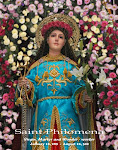
St. Philomena whose feast we celebrate today, was a 13 year old girl who endured 40 days of imprisonment, was scourged, thrown into the river with an anchor tied around her, was subjected to arrows and eventually was beheaded all because she refused the love of an emperor in order to honor a promise of her virginity to Christ. It is highly unthinkable that a girl her age could endure such a long and frightening darkness on her own. She was true to her name “Philomena” which meant “Friend / Daughter of light.” Martyrs like her could not have endured it were it not for the light of their faith that opened their eyes towards a future that made sense of their sufferings. Jesus said, “Do not be afraid any longer, little flock, for your Father is pleased to give you the kingdom.” The reliability of this promise rested on their experience of God’s love that is always dependable. “Faith, received from God as a supernatural gift, becomes a light for our way, guiding our journey through time.” (Lumen Fidei, 4.) “The Lord says, I am the Light of the world. No one who follows me will walk in darkness, but will have the light of life.” (John 8:12)

“Faith demands renouncing the immediate possession which sight would appear to offer; it is an invitation to turn to the source of the light, while respecting the mystery of a countenance which will unveil itself personally in its own good time.” (Lumen Fidei, 13.) We reject instant answers. We patiently wait for God to reveal himself and his will. We constantly turn to the living God in a personal encounter. We entrust ourselves to his merciful love. We willingly let ourselves be constantly transformed and renewed by God’s call. By constantly turning towards the Lord, we discover a sure path which liberates us from the aimless passing of paths that lead to nowhere. We walk by faith and not by sight. We walk a path that is firm and sure. 

Jesus, I trust in you. O Mary conceived without sin, pray for us who have recourse to thee!