Monday, September 9, 2013

Christ first of all; Christ above all

Praised be Jesus, Mary, and Joseph!

First he said that he did not come to bring peace to the world but division: a family will be divided, two against three, three against two. Now, the Lord says: “If anyone comes to me without hating his father and mother, wife and children, brothers and sisters, and even his own life, he cannot be my disciple.” The Lord makes very great demands from those who wish to follow him. To follow the Lord means to make him the priority above all priorities. It means putting Christ above all else that we hold dear: above our properties, above our relationships, above our families, and even above our very own selves. St. Benedict, in his Rule says: “Let them prefer nothing whatever to Christ.” (Rule of St. Benedict, Chapter 72.) Christ before all else. Christ above all else.

Prefer nothing to the Love of Christ
Why such great demands on us his disciples? What right has he to demand from us that he be preferred by us before and above all else? This is answered only by looking at who Jesus is: Jesus is the Son of the living God whom we should love with all that we are and all that we have…with all our souls, with all our minds, with all our hearts and with all our strength. Why is this so? It is because God created everything through Him and FOR Him. He is before everything that exists. He holds all things together in Himself. We belong to him on account of the fact that nothing came to be except through Him. We belong to Him because He bought us at the price of His own Blood. In other words, none could love us more than the way the Lord Jesus does. We owe Him our existence. We owe Him our redemption. We belong to Him, we are His people, the flock He shepherds.

In fact, our love for those who we love – our fathers and mothers, wife and children, brothers and sister, and even ourselves – will only find its true meaning in our love for the Lord. He commands us: Love one another as I have loved you. Only in the love of Christ will we be able to love each other in the right way. The virtue of Charity is the theological virtue by which we love God above all and for his own sake and by which we love our neighbors and ourselves for the sake of Him.
It is only in Christ that we are able to love as he loves – in a detached and pure manner. “Jesus asks us to overcome the instinctive inclination to love in an almost idolatric manner the persons dearest to us.” Loving with “detachment and purity” entails a tremendous amount of self-forgetfulness and self-control. It demands great sacrifice.

Let us prefer nothing to the love of Christ. Let us love him before all and above all. Let our love for each other be pure – that is, let us love each other for the sake of Christ and in imitation of Christ who laid down his life for us his friends. Let us ask our Blessed Mother, whose birth we celebrate today, to help us keep the purity of our hearts and minds. Blessed are the pure of heart, for they shall see God.


Jesus, I trust in you. O Mary conceived without sin, pray for us who have recourse to thee. 

Monday, August 12, 2013

Late Posting: Becoming Rich in the Sight of God


PRAISED BE Jesus, Mary, and Joseph!


The rich man thought that he was a very fulfilled man. He had more than enough of what he needed that he had to tear down his barn to build a larger one. He consoled himself with the thought: “Now you have so many good things stored up for many years. Rest, eat, drink, and be merry!”

But this is not so because the Lord warns us: “Take care to guard against all greed, for though one may be rich, one’s life does not consist of possessions.” One’s life does not consist of possessions because the purpose of life is not to be rich in material possessions but to be rich in God’s sight. St. Paul, in the 2nd reading, reminds us: “Seek what is above, where Christ is seated at the right hand of God. Think of what is above, not what is of earth.” Oftentimes, our hearts are much concerned with the things of the earth at the expense of what is really more important…which would be the salvation of our souls. We are much too concerned with material things that eventually will pass away while we forget that we are meant for eternal life. Material possessions may sustain us at present but these will be left behind when God calls us to depart from this world at the moment of death. Therefore, we should strive to be rich, not with material possessions but to be rich in the sight of God. Fr. Aris Sison said, “To become rich in the sight of God means not to fall into the temptation of anxiety as if everything depends on us. To become rich in the sight of God means to subordinate all – work, goods, and life to God’s Kingdom. To become rich in the sight of God means ‘to give alms’.”

St. John Vianney said: “If someone cheats us once, we say, ‘We will trust him no more – and with good reason.’ The world cheats us continually and we love it. ‘Love not the world, nor the things that are in the world,’ St. John warns us. If we give some thought to what the world really is, we should pass all our lives in bidding it farewell…Everyday, we are bidding farewell to the world. We are like travelers who enjoy the beauty of the countryside through which they are passing. No sooner do they see it than it is time for them to leave it behind. It is exactly the same for the pleasures and the good things to which we have become so attached. Then we arrive at the edge of eternity, which engulfs all these things in its abyss.

“It is then that the world will disappear forever from our eyes and that we shall recognize our folly in having been so attached to it. And all that has been said to us about sin!...Then we shall say: It was all true! Alas, I lived only for the world, I sought nothing but the world in all I did, and now the pleasures and the joys of the world are not for me any longer! They are all slipping from me – this world which I have loved so well, these joys, these pleasures which I have so fully occupied my heart and my soul!

“Now I must return to God! . . . How consoling this thought is for him who sought only God throughout his life! But what a despairing thought for him who has lost sight of God and of the salvation of his soul.” (Sermon of St. John Vianney)

“Vanity of vanities! All things are vanities!” Because of this, “think of what is above, not of what is of the earth. For you have died, and your life is hidden with Christ in God. When Christ appears, then you too will appear in glory.”


Jesus, I trust in you! O Mary conceived without sin, pray for us who have recourse to thee!

We gain fresh vision!

PRAISED BE JESUS, MARY, AND JOSEPH!

The readings today speak of Faith as a light that illumines our path in the darkness of waiting. In his first encyclical entitled Lumen Fidei, our Holy Father made mention of a common misconception that associates faith with darkness: that faith is a “leap in the dark, to be taken in the absence of light, driven by blind emotion” (Francis, Lumen Fidei, 3.) This so called darkness of faith perhaps comes from a misconception of what the Letter to the Hebrews said in the 2nd reading that faith “is the evidence of things not seen” – that faith forces us to uphold things that we do not see nor understand.

Faith is light which illumines every aspect of human life
However, the contrary is true. “Faith is a light…The light of faith…is capable of illuminating every aspect of human existence. A light this powerful…must come from God. Faith is born of an encounter with the living God who calls us and reveals his love…Transformed by this love, we gain fresh vision, new eyes to see; we realize that it contains a great promise of fulfillment, and that a vision of the future opens up before us.” (Lumen Fidei, 4.) The Book of Wisdom (the 1st reading) referred to the night of the Passover in which the People of Israel “awaited the salvation of the just and the destruction of their foes” – in other words, they awaited on that night their liberation from slavery. However, their waiting in the middle of darkness of the night was illumined by faith for they waited “with the sure knowledge of the oaths in which they put their faith.” They were so sure that God would indeed save them for God has made an oath to do so and they know that God fulfills his promises. The Lord bids us to gird our loins and light our lamps and wait like servants waiting for their master to return from a Wedding feast. He tells us to wait and this we do because we know in faith that he will return. Faith illumines our waiting. We just do not sit in the dark without a clue as to what to expect. We know that the Lord will return because he said so. We look forward to the fulfillment of his promise.

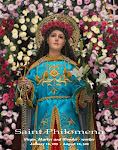
St. Philomena whose feast we celebrate today, was a 13 year old girl who endured 40 days of imprisonment, was scourged, thrown into the river with an anchor tied around her, was subjected to arrows and eventually was beheaded all because she refused the love of an emperor in order to honor a promise of her virginity to Christ. It is highly unthinkable that a girl her age could endure such a long and frightening darkness on her own. She was true to her name “Philomena” which meant “Friend / Daughter of light.” Martyrs like her could not have endured it were it not for the light of their faith that opened their eyes towards a future that made sense of their sufferings. Jesus said, “Do not be afraid any longer, little flock, for your Father is pleased to give you the kingdom.” The reliability of this promise rested on their experience of God’s love that is always dependable. “Faith, received from God as a supernatural gift, becomes a light for our way, guiding our journey through time.” (Lumen Fidei, 4.) “The Lord says, I am the Light of the world. No one who follows me will walk in darkness, but will have the light of life.” (John 8:12)

“Faith demands renouncing the immediate possession which sight would appear to offer; it is an invitation to turn to the source of the light, while respecting the mystery of a countenance which will unveil itself personally in its own good time.” (Lumen Fidei, 13.) We reject instant answers. We patiently wait for God to reveal himself and his will. We constantly turn to the living God in a personal encounter. We entrust ourselves to his merciful love. We willingly let ourselves be constantly transformed and renewed by God’s call. By constantly turning towards the Lord, we discover a sure path which liberates us from the aimless passing of paths that lead to nowhere. We walk by faith and not by sight. We walk a path that is firm and sure. 

Jesus, I trust in you. O Mary conceived without sin, pray for us who have recourse to thee!


Monday, July 22, 2013

Giving the Lord Our Full Attention

Praised be Jesus, Mary, and Joseph

In the Parable of the Good Samaritan, we saw how the Lord Jesus is himself our neighbor because he is the one who treats us with mercy. It is this light of being our neighbor that the Lord is shown as accepting the hospitality of his friends. In the first reading, he accepts the hospitality of Abraham. In the Gospel, he accepts the hospitality of Martha and Mary, the sisters of Lazarus. In fact there were other occasions when the Lord accepted the invitation for him to visit homes and eat at the table of friends: he entered into the homes of Simon the Pharisee, Levi the Tax collector, and also Zacchaeus, another tax collector. As the good neighbor, he allows himself to be invited…and even seeks to be invited by us: “Behold, I stand at the door and knock,” says the Lord, “if anyone hears my voice and opens the door to me, I will enter his house and dine with him and he with me.” He is the Divine Neighbor who accords us the honor of his visit into our homes.

Thus, he entered the home of Martha and Mary. Perhaps, Martha felt so honored with our Lord’s visit that she became engrossed with the details of hospitality. There was nothing wrong with what she did. Hospitality is good. The Letter to the Hebrews reminds us: Do not forget to show hospitality to strangers, for by so doing some people have shown hospitality to angels without knowing it. [Hebrews thirteen verse two] When asked about Mary who sat at the Lord’s feet to listen to him, our Lord did not condemn Martha’s hospitality as evil. Instead, he praised Mary for choosing the better part. What Martha did was good, but what Mary chose was even better. Why is this so?

Martha’s anxiety and worry about many things kept her from giving the Lord her full attention – which was all that the Lord wanted from her. Of course, she served him and looked after his needs. But the Lord did not visit her to be fed. He visited the sisters to feed them with the Words of Everlasting life. Coming in and out of the kitchen, Martha was physically present, but her mind and heart were absent. Choosing to sit at the Lord’s feet to listen to him speak, Mary chose the better part. She gave the Lord her full attention. She was not just present physically. Her mind and her heart were present to the Lord as well. Giving the Lord her full attention, Mary allowed the Lord to transform her by his visit. As Abraham’s life was transformed by the Lord’s visit, so was Mary’s life transformed also by the Lord’s visit. The Lord wanted Martha to do the same – to give him her full attention because he wishes to impart with her the words of eternal life.

And the Lord will do the same for us today. He knocks at the door. He asks that he be received “under our roof.” He wishes to heal our souls and this he will do if only we allow him to enter into our bodies during holy Communion. But once we receive him in Communion, he asks that he be given our full attention. We might waste the potential of this Divine Encounter if, upon receiving him, we rush outside the Church into the parking lot because we are in a hurry to do the chores we intend to accomplish this week-end. Sayang kasi ang bakasyon. But by saying so, we miss the point of the Sunday rest. On this day, we abstain from servile work so that we can give the Lord our full attention. The Sunday rest accords us the opportunity to offer the Lord the time which we usually fail to give him. It is not good to be busy always. We must take time to smell the flowers or better yet, we must take time out to sit at the Lord’s feet to listen to him speak. Give him your full attention. Give him your time. He knocks at the door of your heart. Open it and let him in today and every Sunday. The Lord wants to dine with you today.

Jesus, I trust in you. O Mary conceived without sin, pray for us who have recourse to thee!

Monday, July 15, 2013

Even When We Were Yet Sinners...

Praised be Jesus, Mary, and Joseph

Samaritans and Jews were not exactly friends to each other. If you recall the gospel reading two Sundays ago, there was a Samaritan town that refused to accept Jesus because he was on his way to Jerusalem. The rivalry was as old as the division of Israel into two kingdoms: the northern kingdom (Samaritans) composed of ten tribes of Israel and the southern kingdom (Jews) composed of two kingdoms. On account of the rival temple which the Samaritans built on Mt. Gerizim, the rift between the two peoples reached its peak because the Jews have always held the tradition that the true Temple was built on Mt. Zion (Jerusalem). That is why that the Lord Jesus would make a Samaritan as the protagonist of his parable would strike a sensitive chord in the hearts of the Jewish listeners.

A Samaritan coming to the aid of a Jew who was robbed and left for dead – the parable was more than just a simple lesson of charity beyond boundaries (borders). It was a portrayal of the history of salvation. Man was robbed by the devil of all the riches he has been endowed with by God. After he was robbed, man was left for dead: “Through the disobedience of one man, sin entered into the world, and together with sin, entered death.” (Romans 5:12) The priest and the levite who both passed by the dying man stood for the Jewish religion. They passed the poor man by not because they did not care but because there was nothing that they could do for him.  The religion of the Law told people what to do and what not to do but the same religion could do nothing more than this. It has no power to save.

It was the Samaritan who came to help. Jesus identified himself with the Samaritan because he, who came from heaven, came to help man who was in reality in enmity with God. St. Paul said: “For why did Christ, when as yet we were weak, according to the time, die for the ungodly?  For scarce for a just man will one die; yet perhaps for a good man some one would dare to die.  But God commendeth his charity towards us; because when as yet we were sinners, according to the time, Christ died for us; much more therefore, being now justified by his blood, shall we be saved from wrath through him.  For if, when we were enemies, we were reconciled to God by the death of his Son; much more, being reconciled, shall we be saved by his life.  And not only so; but also we glory in God, through our Lord Jesus Christ, by whom we have now received reconciliation.” (Romans 5: 6-11) This is precisely what Jesus did for us. We were ungodly, we were sinners, and yet he cleaned and bound our wounds and lifted us upon his own flesh by himself dying on the cross. He allowed himself to be beaten and be stripped. He was not left half-dead. He himself went all the way – he died on the Cross. Indeed, the Lord Jesus is truly a neighbor for us. He is the “one who treated him (us) with mercy.” And he commands us to do the same. The Lord said weeks ago: the one who is forgiven much loves much. He bound our wounds. By his stripes we were healed. He treated us with mercy. Let us forgive as we have been forgiven. Let us heal as we were healed. We were forgiven much. Therefore, let us love much.

Jesus, I trust in you. O Mary conceived without sin, pray for us who have recourse to thee.


Monday, July 8, 2013

Late Posting: Following the Lord with Resolute Determination

Praised be Jesus, Mary, and Joseph!

“Jesus resolutely determined to journey to Jerusalem” – one of the themes that characterized the gospel according to St. Luke is the theme of the journey. He spoke of the life of our Lord as one big journey to Jerusalem. Jerusalem was the favorite destination of the Jewish pilgrimage because of the temple of the Lord built on it. Every year, Mary and Joseph went to Jerusalem for the feast of Passover and they brought Jesus with them. But this time, the Lord resolutely went to Jerusalem not simply to celebrate the feast. He went to Jerusalem for his own Passover: the Son of Man was to suffer and die in Jerusalem in order to enter into his glory. It was for this that he came down from heaven. He came to suffer and die in order to redeem us from sins.

He was so determined to fulfill his mission in Jerusalem that he left his own home at Nazareth. That is why he said to the one who expressed his desire to follow him: “Foxes have dens and the birds of the sky have nests but the Son of Man has nowhere to lay his head.” The Lord was so determined to accomplish his task in Jerusalem that when the time for it has come, he bid his own mother goodbye. That is why to the one who would follow him only after the death of his father, the Lord said: “Let the dead bury their dead. But you, go and proclaim the Kingdom of God.” And to the one who wished to bid first his family farewell, the Lord said: “No one who takes a hand to the plow and looks to what was left behind is fit for the kingdom of God.” In other words, the Lord demands that those who wish to follow him must give up mother, father, wife, children, and home…without counting the cost. The Lord is not a home wrecker. Family and home are valuable to him. But even such should not come between a disciple and his mission to proclaim the Kingdom of God. “Seek ye first the kingdom of God and his righteousness, and everything else will be given unto you.” The price of following the Lord is indeed very high and the Lord made this clear to all who wish to follow him: total detachment from everything that the world holds dear: material comforts, possessions, and family ties.

And as the Lord resolutely determined to journey to Jerusalem, so also those who wish to follow him must share in this resolute determination. Hold on to the plow and do not look to what was left behind. Do not regret what you gave up for him. Just as it is not right to take back a gift that has already been given, so do not take back what you have given up for the Lord. Only look forward and set your eyes upon Jesus who waits for you at the end of the journey. Using St. Paul’s words in yesterday’s feast: “Compete well, run the race, keep the faith.” Keep your eyes on the prize. We do not run for a crown of leaves that wither and die. We run for the crown of everlasting life which is definitely worth more than everything we have given up in order to run this race. Christian life is one Amazing Race. Let us run so as to win!


Jesus, I trust in you! O Mary conceived without sin, pray for us who have recourse to thee!

Sent to Gather What was Scattered

Praised be Jesus, Mary, and Joseph!

People oftentimes wonder why Jesus bid his disciples to go from town to town on a mission. Why can’t his disciples stay put like everybody else? The key to the understanding of the itinerant character of the work of the disciples is the message that they bring: “The Kingdom of God is at hand!”  What is the Kingdom of God? The Catechism of the Catholic Church tells us: “God created the world for the sake of communion with his divine life, a communion brought about by the ‘convocation’ of all men in Christ, and this ‘convocation’ is the Church. The Church is the goal of all things.” (CCC, 760). Communion in order to share in the divine life – this is the will of the Father for the world which he created. This communion with the Divine life is the Kingdom of God. Unfortunately, sin destroyed the harmony in which human beings were created: “the control of the soul’s spiritual faculties over the body is shattered; the union of man and woman becomes subject to tensions…Harmony with creation is broken…” (CCC, 400). In other words, sin scattered the children of God.

And this is why God sent his Son into the world. “To carry out the will of the Father, Christ inaugurated the kingdom of heaven on earth. Now the Father’s will is ‘to raise up men to share in his own divine life.’ He does this by gathering men around his Son Jesus Christ. This gathering is the Church, ‘on earth, the seed and beginning of that Kingdom.’” (CCC, 541.) Christ came to gather into unity the scattered children of God. He was raised upon the Cross to gather all people to himself. It is for the sake of gathering the scattered children of God that the disciples are sent from town to town with the message that “the Kingdom of God is at hand.” The work of the disciples, our work is that of gathering. Thus, we have the image of the harvest: “The harvest is abundant but the laborers are few.” The fruits of the death of Jesus must be gathered by the workers – and we are the workers. We go from town to town in search for the children of God. The message that we bring is actually an invitation to draw near to the Lord Jesus so that they may gain access to the Divine Life. We cannot share in the Divine life apart from communion with Jesus. We have to gather around Jesus. And this gathering around Jesus is the Church. We go from town to town to collect people for Jesus. We go from town to town to gather the harvest. We go from town to town to bring people to the Kingdom of God, which is the Church.

We are part of this gathering of people around Jesus. For this reason, we rejoice that our names are written in heaven. And we should share this joy. We should share the blessing that we received. We should go from town to town. We should go from house to house with the invitation to come and join this gathering of people around Jesus. We should seek those who stay away from the Lord. Pope Francis keeps on saying: The Church must not wait for people to come to her. She should go and search for the lost. Let it be our mission to win people for Jesus. We are workers in the Lord’s harvest. Let it be our task to gather and not scatter.


Jesus, I trust in you. O Mary conceived without sin, pray for us who have recourse to thee.