Thursday, November 11, 2010

He alone has the words of Eternal Life


Indeed, sharing in the life of God, a Trinity of love, is complete joy (cf. 1 Jn 1:4). And it is the Church’s gift and unescapable duty to communicate that joy, born of an encounter with the person of Christ, the Word of God in our midst. In a world which often feels that God is superfluous or extraneous, we confess with Peter that he alone has “ the words of eternal life ” (Jn 6:68). There is no greater priority than this: to enable the people of our time once more to encounter God, the God who speaks to us and shares his love so that we might have life in abundance (cf. Jn 10:10).


Benedict XVI, Verbum Domini (Septmeber 30, 2010), 2.

Wednesday, November 10, 2010

His Wrath Upon Their Heads


Fr. Raymond de Souza has given a voice to our brethren who are persecuted in Iraq.

"Christians have been in Iraq from the earliest centuries, long before there was an Iraq or, one might note, there was Islam. Jihadists have launched a campaign with genocidal intent, aimed at driving out every last Christian from what they consider to be an Islamic land. It is now clear that the only place such jihadists envision for Christians in Iraq is the grave.

The Catholic archbishop has been killed. Priests have been riddled with bullets upon leaving their churches. Ordinary Christians, trying to live a quiet life, have been subject to harassment, threats and violence. Iraq in the aftermath of the American invasion has been particularly dangerous, but antiChristian violence stretches across the Islamic world."

"The blood on the altar makes it clear. No amount of goodwill, no amount of dialogue, no amount of circumlocutory evasions, no amount of supine prostrations – nothing will dissuade the jihadists. So let us not abnegate ourselves over the dead bodies of our fallen brethren in Christ. Let us speak frankly of those who want to kill us.

Allahu Akbar – God is great! So those Catholics on Sunday heard the jihadists shout in the church. Can there be any greater sacrilege than to kill the innocent at prayer, while shouting that God is great?

The jihadists respect neither man nor God, not even their own. They have killed their fellow Muslims and bombed mosques. The Christians killed on Sunday were Iraqis, their fellow Arabs, their fellow citizens, their neighbours. They kill because they are seized with a murderous hatred. The least we can do is to summon a righteous anger in return."


Read his entire article by following the link: His Wrath Upon Their Heads

Tuesday, November 2, 2010

All the Faithful Departed


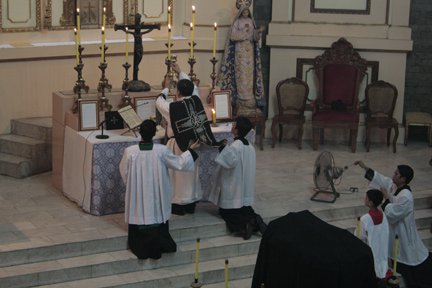
Some pictures from the Requiem Mass on All Souls' Day from PLDM. Thanks Gerard Cenir for the pictures.


On Death and Judgment


Yesterday, we were talking about the realism of the Saints in contrast to the accusation of the world that the Church is not in touch with reality. Today, our commemoration of the faithful departed brings to mind realities which the world prefers not to think of – namely, death and judgment. Contrary to the claim that the world we live in is truly in touch with reality, it is truly in state of denial. By the bombardment of images of youthful beauty, the world tries to deny that one reality which, whether we like or not, will one day confront us all – and that is Death. And because it denies death, the world also tries to brush under the rug the reality of judgment. The world detests the thought of responsibility for everything we think, say, and do.

And yet, no matter how vehemently the world tries to deny these realities, the truth remains: there is death and judgment. One day, we shall die and the world is afraid of this. This fear of death comes from the fact that it does not have any idea of what lies beyond it. Denying what is invisible, the world sees nothing beyond the materiality of death. Thus, death to the eyes of the world is simply the end: the end of life, the end of relationships, and the end of existence. And this thought drives man to take all he can out of life – to eat, drink, and be merry because tomorrow we die. Live without accountability. Enjoy without responsibility. Nothing waits for you at the end.

But such is a very naïve view of human life. To limit human life to simply what is temporal is to cheat man of the great destiny that is truly his. Reality is not simply limited to the temporal. Temporality is but a small portion of what we call “reality.” Beyond it is the bigger part, the more substantial part and that is the Eternal. I was struck by what Archbishop Ramon Arguelles said this morning. He said that of the three sectors of the kingdom of God, ours (the Church Militant) is the smallest. For if only we take to mind the actual number of those who have gone before us in death – those who compose both the Church Triumphant and the Church Suffering – we who are on earth, the Church Militant, will simply be a minority. And this is true. We are not the only ones alive. Those in heaven and in purgatory are also very much alive. Death did not end their existence. St. Therese in her last moments said: “I am not dying. I am entering into life!” When people say that life is short, I agree only to the extent that “life” here is meant to refer to life on earth. And indeed, it is very short as compared to the eternity that awaits us. And yet, short though it may be, it is so decisive that it determines the quality of our eternity. Our eternity will be the retribution that we shall receive at the moment of death (CCC, 1022). This eternity will either be entrance into the blessedness of heaven – either through a purification or immediately, - or immediate and eternal damnation.

Eternal retribution speaks of accountability. It involves judgment, reward, and punishment. Divine Revelation puts names to these realities: Heaven and Hell. Of course, hell is outside the Kingdom of God. It is the place of punishment and exclusion for those who have persistently rejected Divine Mercy through mortal sin. Heaven, which we have meditated on yesterday, is the place of reward and communion with the Blessed Trinity. How we all wish that at the end of our lives, we could enter Heaven as a just reward. However, the beauty of Paradise could not admit the ugliness of sin: “Nothing impure can enter Heaven.” The perfection of God is the high standard of Heaven: “Be perfect as the Heavenly Father is perfect.” Our obsession with perfection on earth is not yet quite the perfection that is the Father’s. Our perception of goodness is not yet quite close to the Holiness of the Father which is beyond all our imagining. We oftentimes think that what we have done is good enough only to find out at judgment that it is not quite proximate to the Holiness that is the Father’s. Oh how we wish that it were as easy as rounding off fractions to the next power, but it is not. Jesus said, “You will not be released until you have paid the last penny.” The justice of God is exacting. Yes, He is Merciful, but He is also Just. It will be in Purgatory that we shall realize that the sin we once disregarded as trivial will involve so much reparation and purification. It will be in Purgatory that we shall realize how thorough the Lord’s judgment is. No thought, no word, no act – even the most covert, the most hidden – will be unaccounted. Everything will be reviewed. Every moment will be considered.

This is why we cannot afford to trivialize anything. We cannot afford denying the truth of accountability and judgment. But how can we ever achieve the perfection which the Father requires? How can we be perfect as the Father in heaven is perfect? Think: who is as perfect as the Father is perfect? Is He not His only begotten Son? And how was the Son made perfect in obedience? The Letter to the Hebrews says: Jesus learned obedience through suffering. And when perfected, He became the source of salvation of those who believe in Him. He was made perfect in suffering. The Cross, which we oftentimes trivialize, is the instrument of heavenly perfection. The Cross, which we wish we could do without, is the one necessary instrument by which our lives might be perfectly conformed to Jesus. It is by suffering that we are purified. It is by suffering that we are perfected.

And when a man’s voluntary sufferings on earth are not enough to atone for his sins, he bears the remainder in Purgatory. And in the wonderful mystery of the Communion of Saints, we can augment their deficit with our own sacrifices and prayers. “The Church, in its pilgrim members, from the earliest days of the Christian religion, has honored with great respect the memory of the dead; and ‘because it is a holy and a wholesome thought to pray for the dead that they may be loosed from their sins,’ she offers her suffrages for them. Our prayer for them is capable not only of helping them, but also of making intercession for us effective.” (CCC, 958.) The Communion of Saints involves the communion in Charity. It is a communion that is not destroyed by death. Beyond death, we continue to bear one another’s burden. And this mutual carrying of burdens has only one interest in mind: that of helping each other be perfect as the Father is perfect.

Monday, November 1, 2010

On the Realism of the Saints


One of the accusations of the world against the Church is that she is out of touch with reality. The pragmatists say that our eyes raised to heaven keep us from seeing the reality of earth. The saints, who we honor today, are merely saccharine figures that are oblivious to the travails of the present life – the struggle to earn a daily living, the difficulties of making ends meet. Heaven, to these people, is simply an escape devised by religion – an escape from the real deal of day to day living.

But none can really be further from the truth. Saints had a share of what pragmatists call “reality”. The beatitudes give us categories for holiness. Looking at the list of the people whom the Lord calls blessed, one cannot help but notice that these people are not really living in ivory towers, oblivious of the difficulties of life on earth. For who could be more realist than the poor in spirit, or the hungry and thirsty for justice, or those who mourn? Who is more exposed to violence than the peacemaker or the merciful or the persecuted for righteousness’ sake? Who is more in touch with one’s humanity than the pure of heart? Could anything be more “real” than the beatitudes?

And yet, although the saints have been immersed in the sea of suffering which is the common lot of all humanity, they have risen above the seemingly hopeless human situation. When asked by the elder about the saints: “Who are these wearing white robes, and where did they come from?” the visionary of the Book of Revelation got the answer: “These are the ones who have survived the time of great distress; they have washed their robes and made them white in the Blood of the Lamb.” The saints are the real survivors of the struggles of this life – not the artificially stranded people whose tasks consisted in games and contests, and definitely not housemates whose tasks veer toward stupidity and foolishness. The saints are the ones who have survived the great distress. They are the ones who have shown us the real stuff that our humanity is made of and meant for.

Fr. George Rutler has very deep insights about this matter: “The anthropocentric materialist is easily exploited because he does not see the whole picture: he sees only the temporal portion of the world which was given to him at Creation, and that is as obtuse as looking at a painting and seeing only paint. The celestial perspective is more organic than that. It cannot figure as ‘pie in the sky;’ it is why we enjoy the taste of pie on earth, and bless Heaven for us. It is not the silver cup at the end of a race; it is the race. Job called it warfare (7:1).” (G. Rutler, The Four Last Things, 175.)

To see the paint and to miss the painting – this is the shortsightedness that many pragmatists have condemned the world to. By concerning ourselves exclusively to functionality, we have lost sight of what is exalted in the human nature. “While the most humane and effective social institutions have been the work of people with their eyes on Heaven, the worst human catastrophes have been engineered by people with their eyes on the ground. Adjusting the scales of temporal justice without recourse to Heaven as the standard measure is…unreliable…The lack of adequate reference helped the carve…(the) contrast(s) between Margaret Sanger advocating the reduction of certain racial groups with Mother Teresa reclaiming the poorest of the poor. Miss Sanger did not succeed in solving the over-population of poor countries, although she prepared the way for what is becoming the underpopulation of rich countries. Mother Teresa has not increased starvation by rescuing infants, but she has identified a new impoverishment of the spirit in the best nourished societies. In tracing the progress of social justice, the one generalization which holds valid and which may be maintained without temerity is this: a reformer who does not hope to form souls for Heaven is quite likely to become a reformer with a vendetta” (Ibid., 177-178.).

“It is useless to reform the world until the world is first transformed. It is quite as futile to speak of doing anything to my world unless it is also done to me” (Ibid, 179.). Christ transformed the world through his death and resurrection. He transformed the world by making saints out of ordinary mortals. The Holy Spirit enabled the saints to raise their eyes to Heaven so that they could make sense of what they find on earth. The Holy Spirit revealed to the Saints and to us what the world does not know: the Father. Having known the Father, we know who we really are and for what we were meant to be: we are children of God and we are meant to be with Him in Heaven. This is the exalted vocation of our humanity. Life to us is more than food and clothing. That is why we do something more than just worry about what to eat and what to wear. “We are God’s children now; what we shall be has not yet been revealed. We do know that when it is revealed we shall be like him, for we shall see him as he is. Everyone who has this hope based on Him makes himself pure, as Christ is pure.” “Blessed are the pure of heart, for they shall see God.”

On the Obligation of the State to Recognize Christ the King


"Nations will be reminded by the annual celebration of this feast that not only private individuals but also rulers and princes are bound to give public honor and obedience to Christ. It will call to their minds the thought of the Last Judgment, wherein Christ, who has been cast out of public life, despised, neglected, and ignored, will most severely avenge these insults; for His Kingly dignity demands that the State should take account of the Commandments of God and of Christian principles, both in making laws and in administering justice, and also in providing for the young a sound moral education."
Pope Pius XI, Quas Primas (December 11, 1925), 32.